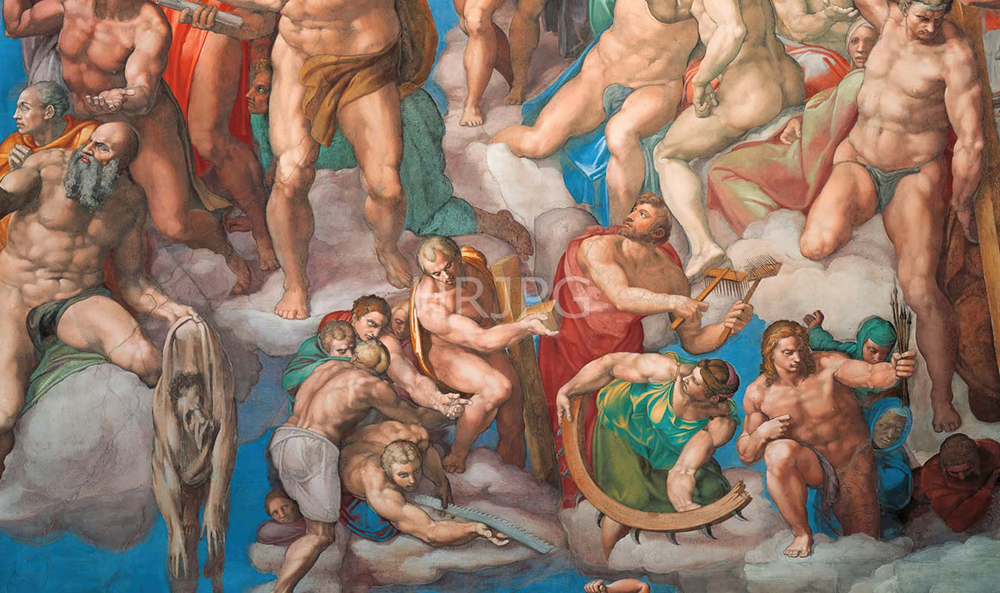
This specific detail from the lower right section of "The Last Judgment" features a group of prominent saints and martyrs, notably Saint Bartholomew and Saint Catherine of Alexandria. Michelangelo portrays these figures with a heroic, muscular anatomy that emphasizes their spiritual strength and the physical reality of their sacrifice. Saint Bartholomew is shown holding his flayed skin, while Saint Catherine is depicted with a fragment of the spiked wheel, the instrument of her attempted execution. The presence of these saints in the judgment scene serves as a powerful reminder of the path to salvation through faith and endurance, reflecting the theological intensity of the mid-16th-century Catholic Church.
The technical execution of this detail highlights Michelangelo’s ability to coordinate complex group compositions within the vast scale of the fresco. He utilize strong "chiaroscuro" to project the figures forward, creating a powerful sense of three-dimensional volume and rhythmic movement. The interaction between the saints—suggested by their focused gazes toward the central figure of Christ—conveys a state of solemn recognition and divine grace. Michelangelo’s focus on the individual attributes of the martyrs allows the viewer to identify the specific historical and sacred narratives within the larger cosmic event. The modeling of the flesh and the heavy, articulated drapery reflect the artists sculptural approach to painting, making the characters appear as solid, permanent presences in the sacred space of the chapel.
Historically, this section of the fresco reflects the Counter-Reformation’s emphasis on the cult of the saints and the importance of martyrdom as a model for the faithful. Michelangelo’s interpretation avoids traditional static iconography, instead showing the saints as active participants in the drama of judgment. This work has been admired for centuries for its psychological depth and its technical brilliance. It stands as a testament to the artists ability to combine anatomical rigor with a profound spiritual narrative, securing his status as the supreme master of the human condition. By studying this detail, scholars gain insight into how Michelangelo transformed his scientific studies of the human body into a visceral visual language of faith, standing as a hauntingly beautiful reminder of the power of the fresco to capture the deepest mysteries of sacred history.