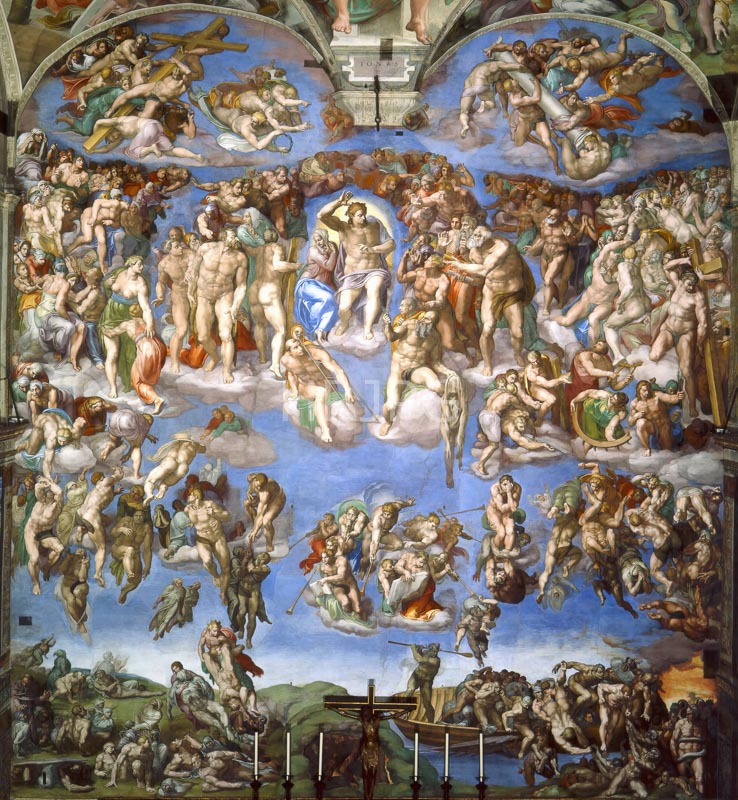
"The Last Judgment" stands as the final, monumental statement in the decorative program of the Sistine Chapel, executed by Michelangelo more than twenty years after he completed the ceiling. Commissioned by Pope Paul III, the fresco covers the entire altar wall and depicts the Second Coming of Christ and the final separation of humanity into the saved and the damned. Michelangelo created a unified, swirling composition centered on the Herculean and youthful Christ the Judge. This work is characterized by its dramatic intensity, its complex multi-figure arrangements, and its profound psychological depth, reflecting the religious anxieties and the shifting artistic styles of the late Renaissance toward the more expressive and contorted Mannerism.
The technical execution of the "Last Judgment" is a tour de force of scale and anatomical complexity. Michelangelo utilizes his deep understanding of human physiology to show over three hundred figures in various states of extreme motion and emotional raw energy. The use of "chiaroscuro" is exceptionally powerful, creating a sense of three-dimensional volume that makes the figures appear to surged forward into the viewer’s space. The composition moves from the rising of the dead in the lower left to the angels carrying the instruments of the Passion at the top, and finally to the infernal regions in the lower right. This movement creates a rhythmic flow that unifies the diverse narrative elements into a singular, cosmic event that captures the terrifying majesty of divine justice and the ultimate fate of the soul.
Historically, the unveiling of the fresco was a major cultural event that met with both immense admiration and significant controversy. The extensive nudity of the figures led to a campaign to "brazen" them with drapery, reflecting the stricter moral climate of the Counter-Reformation. Despite this, the work revolutionized religious art, setting a new standard for psychological intensity and visionary power. Technically, it demonstrates Michelangelo’s supreme confidence in the fresco medium and his ability to bridge the gap between human anatomy and divine mystery. It remains one of the most powerful and influential works in Western culture, standing as an enduring testament to the genius of an artist who captured the entire spectrum of human and divine experience within a crystalline visual language of peak elegance and profound spiritual truth.