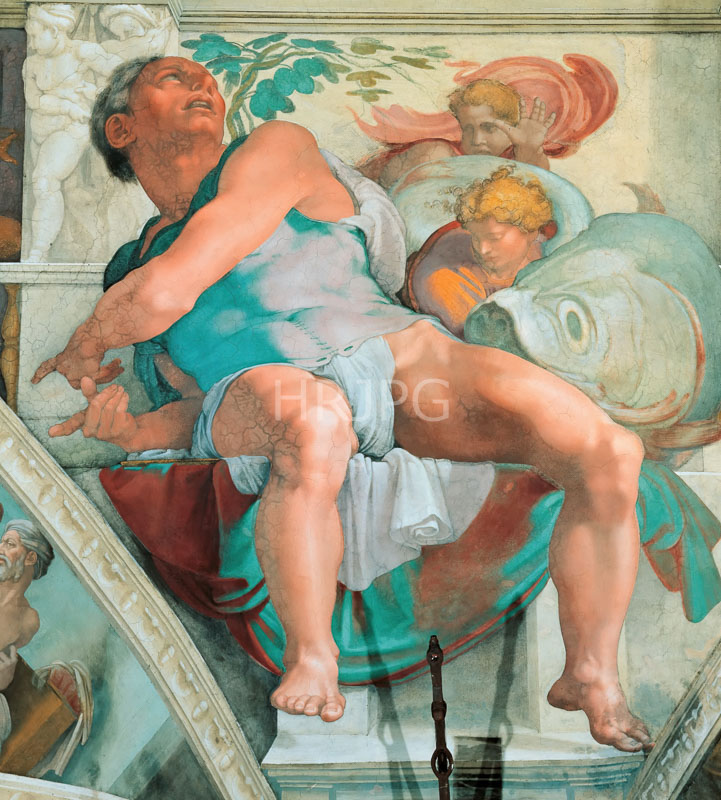
The Prophet Jonah is the most dynamic and technically daring figure among the seven Hebrew prophets on the Sistine Chapel ceiling. Positioned directly above the altar, Jonah is shown in a remarkably foreshortened pose, leaning back as he looks up toward the central scene of God dividing Light from Darkness. This pose is a tour de force of spatial perspective, showcasing Michelangelo’s ability to manipulate the curved architectural space of the ceiling to create a sense of three-dimensional movement. Jonah represents the concept of resurrection, as his three days spent in the whale were seen as a prefiguration of Christ’s three days in the tomb, making him the ultimate symbol of spiritual renewal and hope within the chapel.
The technical execution of Jonah highlights Michelangelo’s shift toward larger, more monumental figure types in the second phase of the ceiling project. The prophet is rendered with a heroic muscularity and a vibrant color palette of yellow and green, making him a focal point of the decorative scheme. Beside him, the large fish (or whale) serves as a symbolic attribute and a narrative anchor. Michelangelo uses a sophisticated "chiaroscuro" to define the physical volume of the figure, making him appear as a solid, living presence surging out of the architectural niche. The focused, visionary expression on Jonah’s face conveys a state of divine awe and intellectual realization, embodying the peak of High Renaissance artistic idealism where the human form is the primary vessel for the spirit.
Historically, Jonah’s placement above the altar reinforces the liturgical connection between the Old Testament prophecy and the sacrifice of the Mass. His dynamic pose breaks the static traditions of prophetic iconography, introducing a sense of "terribilità" and emotional energy that would influence the development of Mannerist art. Technically, the fresco demonstrates Michelangelo’s supreme mastery of the medium and his ability to solve complex architectural challenges through visionary drawing. It remains one of the most admired figures on the ceiling, standing as an enduring testament to the artist’s unique genius and his ability to translate the deepest mysteries of faith into a visceral and enduring visual language. Jonah serves as a powerful reminder of the transformative power of divine intervention and the search for spiritual truth at the dawn of the modern era.