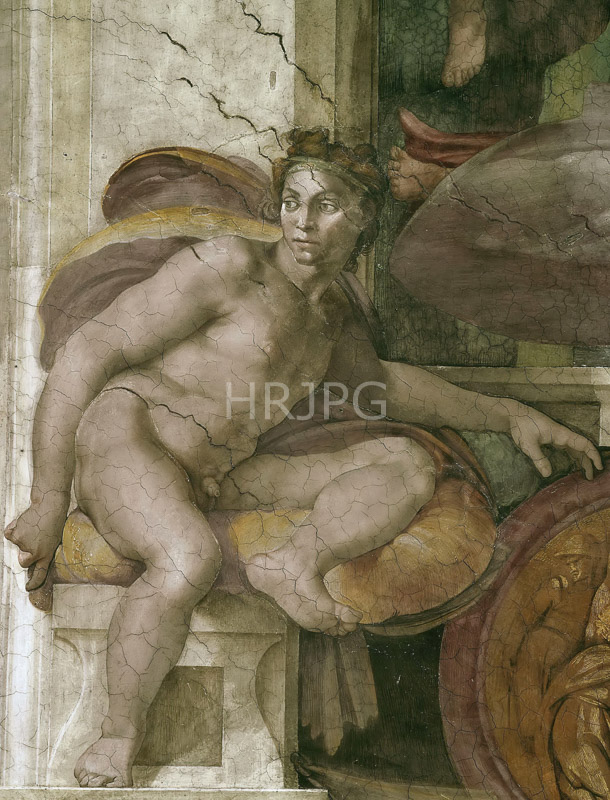
This Ignudo, positioned directly above the magnificent Libyan Sibyl, is part of the final and most mature phase of Michelangelo’s work on the Sistine Chapel ceiling. The figure shows the artist’s shift toward larger, more heroic, and more complex anatomical types. He is depicted in a powerful, twisting pose that mirrors the "figura serpentinata" of the Sibyl below, creating a rhythmic vertical connection that unifies the architectural program. Michelangelo utilize this youth to explore extreme states of muscular tension and spatial movement, using the human form to define the boundaries of the decorative space. The Ignudo holds a large garland, his body modeled with a sculptural solidity that reflects Michelangelo’s identity as a carver of stone translated into the fluid medium of fresco.
The technical execution of this figure is a tour de force of late High Renaissance style. Michelangelo employ strong "chiaroscuro" and bold brushstrokes to create a sense of monumental volume that is legible from the chapel floor. The play of light across the youth’s back and shoulders emphasizes the ripple of muscles and the structural integrity of the human frame. The focused expression and the complex arrangement of the limbs convey a profound psychological intensity, reflecting the artist’s own restless creative spirit and his late-life contemplations on divine grace. This focus on the "motions of the mind" through anatomical contortion became a primary influence on the development of Mannerist art, where the limits of the human form were pushed to their expressive extremes.
Historically, the Ignudi above the Libyan Sibyl are considered some of the most technically perfect figures in the chapel. They represent the culmination of four years of intense physical and intellectual labor, where Michelangelo successfully synthesized his scientific studies of anatomy with a visionary religious aesthetic. These figures served as a "school of the world" for later artists, who flocked to the Vatican to study the master’s innovations in proportion and movement. This specific Ignudo stands as a testament to the enduring power of the male nude as a sacred vessel for expressing the majesty of the divine plan. It remains a vital subject of study for its technical brilliance and its role in redefining the boundaries of Western art, securing Michelangelo’s status as the supreme master of form and emotion across the centuries.