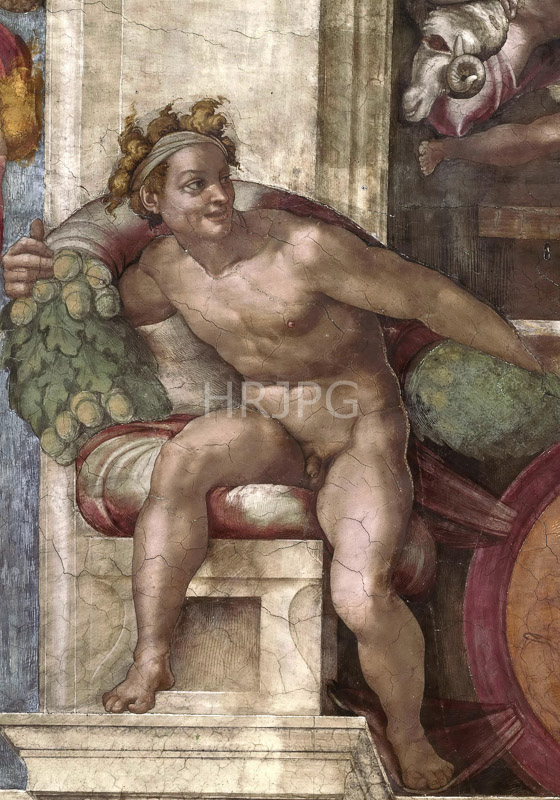
The Ignudo positioned above the Persian Sibyl is a striking example of Michelangelo’s ability to combine monumental power with a sense of graceful, almost musical rhythm. As one of the twenty decorative youths framing the Genesis narratives, he contributes to the sense of cosmic order and divine celebration that permeates the ceiling. The youth is depicted in a complex, seated pose, his body twisting to hold the oak-leaf garlands that anchor the decorative scheme. Michelangelo utilizes his deep understanding of human physiology to show the tension of the muscles and the balance of the weight, creating a figure that feels physically present and psychologically alive. This focus on the heroic male nude reflects the Renaissance belief that humanity is the center of God’s creation.
The technical execution highlights Michelangelo’s mastery of the "non-finito" effect and sophisticated modeling. He utilize soft transitions between light and shadow to define the volume of the torso, while using sharper outlines for the limbs to emphasize their movement in space. The youth’s facial expression is one of quiet contemplation, mirroring the spiritual focus of the Persian Sibyl below. The use of "chiaroscuro" projects the figure forward, making him appear as a three-dimensional sculpture carved from light within the architectural framework. Michelangelo’s unique ability to infuse stone-like solidity into the fresco medium is at its peak here, showcasing the transition from the stable forms of his earlier panels toward a more dynamic and expressive late style.
Historically, the Ignudi above the Persian Sibyl were praised for their perfect proportions and their contribution to the chapel’s unified atmosphere. They reflect the influence of classical antiquity, particularly the discovery of the "Laocoon" and other Hellenistic sculptures, which Michelangelo synthesized with biblical theology. Technically, the fresco demonstrates the artist’s supreme confidence and his ability to work under the most challenging physical conditions to produce a work of eternal significance. This specific youth stands as a testament to Michelangelo’s unique genius and his belief that the human form is the ultimate vessel for spiritual truth. It remains a vital piece of the Sistine puzzle, providing insight into the creative process of an artist who sought to capture the entire spectrum of human and divine experience within a single, crystalline visual language.