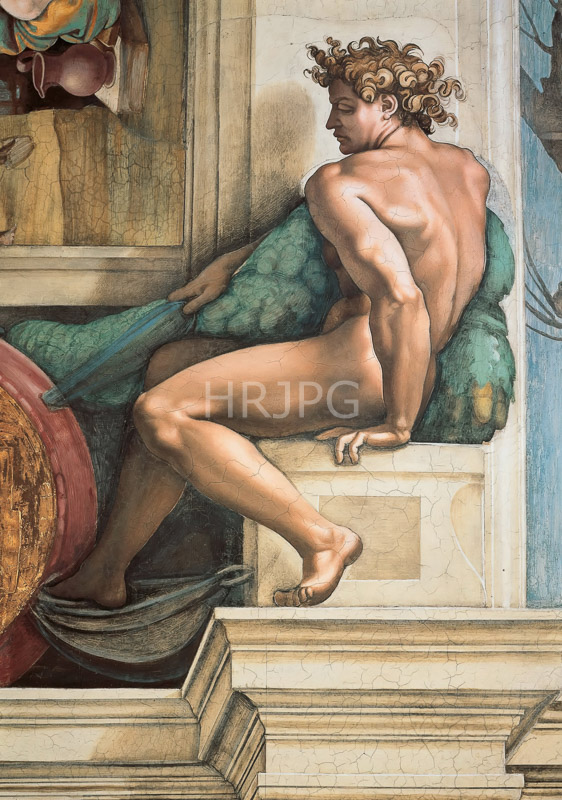
This Ignudo, located above the youthful and visionary Delphic Sibyl, is part of the first phase of the Sistine Chapel ceiling project. Michelangelo depicts him with an idealized physical beauty that reflects the early High Renaissance search for a perfect synthesis of the material and the spiritual. The youth is shown in a balanced, yet dynamic pose, holding the silk ribbons that connect the architectural elements of the vault. His form is modeled with a clarity and a radiance that echoes the lyrical grace of the Sibyl below. Michelangelo uses this figure to establish the heroic scale of the decorative program, demonstrating how the human body can serve as a transition between the earthly realm and the divine narratives of creation.
The technical execution of this figure showcases Michelangelo’s early mastery of the fresco medium. He utilize a bright, luminous color palette and soft "sfumato" to model the features, giving the youth a porcelain-like quality that is both noble and ethereal. The play of light across the muscular ripples of the chest and arms creates a powerful sense of three-dimensional volume, making him appear as a living presence within the sacred space. Michelangelo’s focus on anatomical precision is balanced by a sense of rhythmic harmony, where every limb and gesture contributes to the overall stability of the composition. This figure reflects the artist’s deep respect for the Florentine tradition and his effort to master the weight and volume of monumental figures that characterized the works of his predecessors.
Historically, the Ignudi above the Delphic Sibyl were highly admired for their grace and their contribution to the ceiling’s clear and legible narrative structure. They represent a moment of peak artistic confidence, where Michelangelo successfully combined the scientific study of anatomy with a serene and idealized aesthetic. These figures were influential in establishing the "classic" Renaissance nude, inspiring generations of artists across Europe. Technically, the fresco demonstrates the artist’s ability to coordinate complex spatial arrangements and to imbue even decorative elements with a profound sense of dignity and purpose. This specific youth remains a vital subject of study for its technical brilliance and its role in the foundation of Michelangelo’s monumental figure style, standing as a testament to the enduring power of the human form as a sacred vessel.