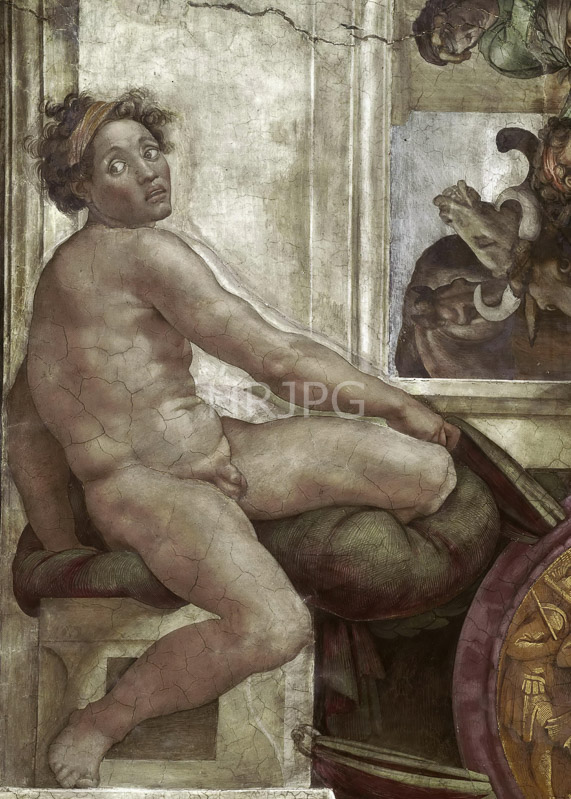
The Ignudo positioned near the "Sacrifice of Noah" panel is characterized by a remarkable sense of physical tension and psychological energy. Michelangelo depicts this youth in a complex, lunging pose that reflects the drama and the physical effort involved in the narrative scene below. Holding the garlands of oak leaves, the figure serves as a dynamic architectural anchor that leads the viewer’s eye through the vast decorative scheme of the ceiling. Michelangelo utilizes his unrivaled mastery of foreshortening to show the figure twisting in space, creating a sense of raw power and rhythmic motion. This focus on the human body in extreme states of exertion is a hallmark of Michelangelo’s middle-period style on the ceiling, where the figures become increasingly monumental.
The technical execution of this figure involves a sophisticated use of "chiaroscuro" to define the muscularity of the torso and the tension of the limbs. Michelangelo uses dense hatching and bold brushstrokes to create a sense of three-dimensional depth, making the youth appear as a sculptural presence that surges forward from the architectural niche. The focused and slightly intense expression on his face conveys a state of divine alertness, reflecting the spiritual significance of the biblical event he frames. The play of light across the damp-looking skin and the articulated folds of the ribbons adds to the tactile realism of the scene. This work reflects the artist’s belief that the human form is the primary site of both artistic and spiritual significance, capable of expressing the most profound mysteries of the faith through anatomical pose.
Historically, the Ignudi associated with the "Sacrifice of Noah" were noted for their contribution to the ceiling’s increasing dramatic intensity. They reflect Michelangelo’s shift away from the stable poses of his early panels toward a more turbulent and emotionally raw style. Technically, the fresco demonstrates the artist’s ability to organize a massive multi-figure composition while maintaining the psychological impact of each individual character. These youths remain a cornerstone of Western art history, standing as a testament to Michelangelo’s unique creative genius and his ability to capture the terrifying majesty of the divine will. By studying this specific Ignudo, scholars gain insight into the restless and visionary spirit of a master who sought to capture the entire spectrum of human experience within a singular, crystalline visual language of peak elegance and profound human relevance.