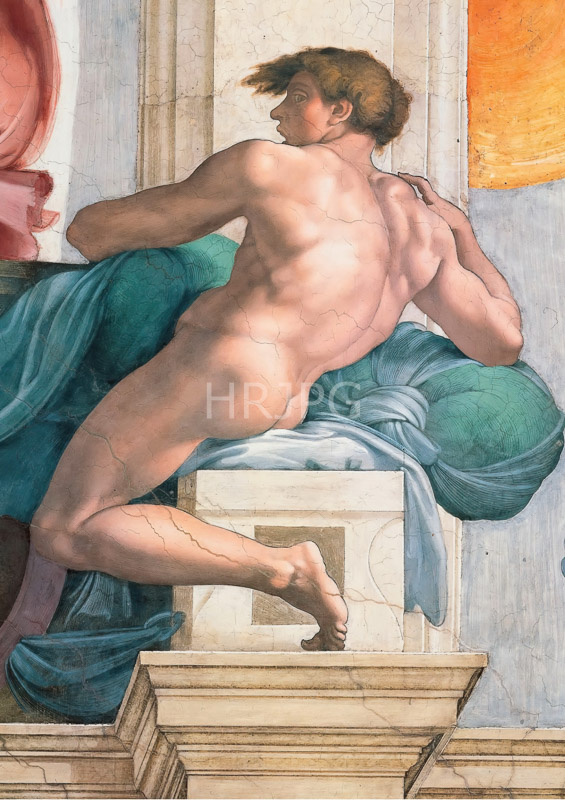
This Ignudo, positioned next to the "Separation of Land and Water," is a powerful example of Michelangelo’s ability to infuse stone-like solidity into the fluid medium of fresco. Depicted in a complex twisting motion, the youth demonstrates the artist’s profound study of classical antiquity and his search for a perfect synthesis of beauty and power. As God commands the elements in the central panel, this figure echoes that divine authority through his own heroic anatomy and balanced, yet dynamic, pose. The Ignudi in this section of the ceiling are significantly larger and more muscular than those in the earlier panels, reflecting Michelangelo’s growing confidence and his shift toward a more monumental and "terribile" figure style that would define the final phase of the project.
The technical execution of this figure highlights Michelangelo’s mastery of volume and foreshortening. He utilize strong "chiaroscuro" to model the ripple of muscles and the structural integrity of the human frame, making the youth appear as a three-dimensional sculpture carved from the very atmosphere of the judgment sky. The play of light across the skin gives the youth a luminous quality, contrasting with the somber and muted tones of the architectural framework. Michelangelo’s focus on the hands and eyes as the primary vehicles of expression is evident here, capturing a state of divine realization and intellectual focus. This rhythmic harmony and the use of the "figura serpentinata" create a sense of potential energy that unifies the diverse decorative and narrative elements of the ceiling into a singular, cosmic event.
Historically, the Ignudi near the "Separation of Land and Water" were highly influential in establishing the late High Renaissance aesthetic. They reflect the intellectual climate of Rome, where the human form was seen as the ultimate expression of divine spirit and cosmic order. Technically, the fresco demonstrates Michelangelo’s supreme mastery of the medium and his ability to work under the most challenging physical conditions to produce a work of eternal significance. This specific youth stands as a testament to the artist’s unique genius and his belief that the human body is a sacred vessel for expressing the majesty of the divine plan. It remains a vital piece of the Sistine puzzle, providing a profound meditation on human potential and the terrifying power of the divine will at the dawn of the modern era.