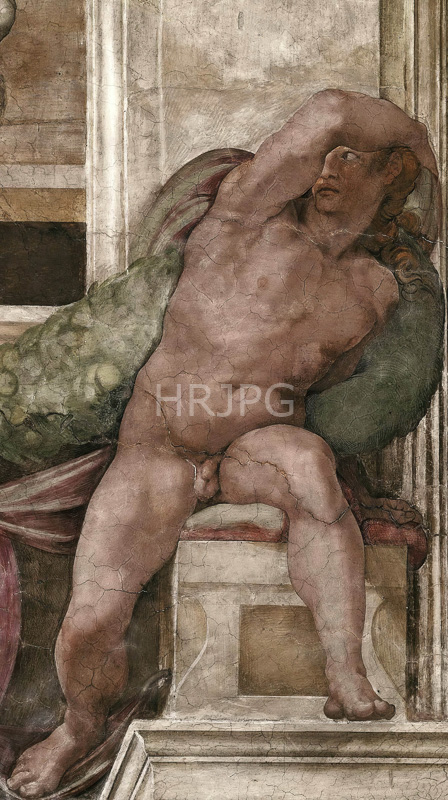
This specific Ignudo sits to the right of the Prophet Isaiah, displaying a thoughtful and slightly melancholy expression that reflects the spiritual gravity of the prophetic message. Michelangelo utilize subtle shifts in lighting and anatomy to give each of the twenty Ignudi a unique personality, transforming them from mere decorative motifs into profound explorations of individual human existence. The youth is shown in a state of quiet repose, his body modeled with a sculptural solidity that anchors the beginning of the ceiling’s narrative sequence. The balanced and harmonious pose exemplifies the early High Renaissance search for a perfect synthesis of physical beauty and intellectual dignity, where the human form is elevated to represent the divine order of the universe.
The technical execution highlights Michelangelo’s early mastery of "sfumato" and soft transitions. He utilize a sophisticated layering of pigments to create a sense of lifelike skin texture and powerful muscular definition. The play of light across the youth’s torso emphasizes the three-dimensional volume, making him appear as a solid, permanent presence within the architectural niche. Michelangelo’s focus on the "motions of the mind" is evident in the youth’s focused gaze and the contemplative positioning of his hands, suggesting an internal psychological depth that mirrors the prophetic focus of Isaiah. The use of rhythmic outlines and subtle shading creates a sense of atmospheric depth, projecting the figure forward and engaging the viewer in a direct spiritual and aesthetic dialogue at the dawn of the 16th century.
Historically, the Ignudi near Isaiah were highly admired for their grace and their contribution to the ceiling’s clear and legible narrative structure. They reflect the intellectual climate of Florence and Rome, where the pursuit of anatomical idealism was inextricably linked to the revival of classical antiquity and the defense of Catholic orthodoxy. Technically, the fresco demonstrates Michelangelo’s supreme confidence and his ability to organize a massive multi-figure composition while maintaining the psychological impact of each individual character. This specific youth stands as a testament to the artist’s unique genius and his belief that the human body is the ultimate vessel for spiritual truth. It remains a vital object of study for its technical brilliance and its role in the foundation of Michelangelo’s monumental figure style, standing as a hauntingly beautiful icon of the Renaissance ideal.