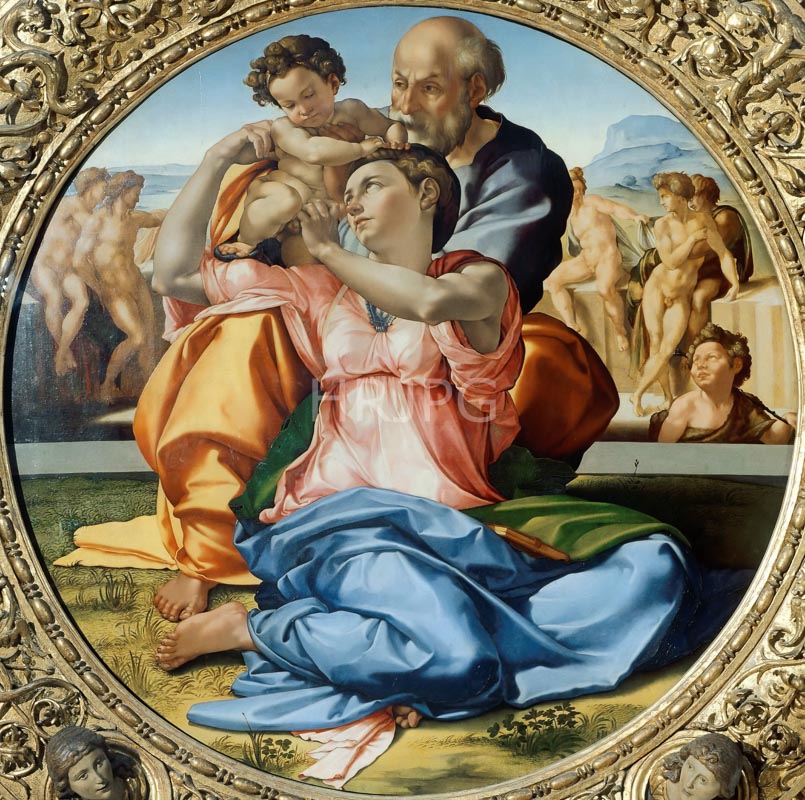
The Doni Tondo, or "The Holy Family," is the only finished panel painting by Michelangelo that survives, and it stands as a pivotal masterpiece of the High Renaissance. Commissioned by the Florentine merchant Agnolo Doni to celebrate either his marriage to Maddalena Strozzi or the birth of their daughter, the circular painting (tondo) depicts the Virgin Mary, Saint Joseph, and the Christ Child in a complex, sculptural arrangement. Michelangelo breaks away from traditional domestic portrayals, instead creating a monumental and physically integrated family unit. The Virgin is shown in a dynamic, twisting pose (the "figura serpentinata") as she reaches back over her shoulder to receive the infant Jesus from Joseph. This work serves as a crucial bridge between Michelangelo’s early sculpture, such as the "Pietà," and the heroic figure types he would soon develop for the Sistine Chapel ceiling.
The technical execution of the Doni Tondo is a masterclass in the use of "cangiantismo," a technique where the artist uses bright, saturated, and shifting colors to model form rather than simple tonal variations. The brilliant oranges, blues, and pinks of the garments possess a metallic clarity that emphasizes the sculptural volume of the figures. In the background, a row of youthful nude figures (ignudi) leans against a low wall, separated from the Holy Family by a small Saint John the Baptist. These nudes are often interpreted through a Neo-Platonic lens as representing the pagan era (sub lege) before the coming of Christ, while the Holy Family represents the new era of grace. The meticulous detail in the foreground flora and the soft, atmospheric perspective of the distant landscape demonstrate Michelangelo’s ability to compete with the masters of oil painting, even while maintaining his primary identity as a sculptor of stone.
Historically, the Doni Tondo is significant for its influence on the development of Mannerism. The exaggerated poses, the vibrant and sometimes artificial color palette, and the intellectual complexity of the iconography set a new standard for artistic virtuosity. The original carved frame, possibly designed by Michelangelo himself, integrates the family arms of the Doni and Strozzi, further grounding the work in its specific social and historical context. Today, housed in the Uffizi Gallery in Florence, it remains one of the most studied and admired paintings in the world. It stands as a testament to Michelangelo’s unique genius to imbue a traditional religious subject with a modern sense of physical weight and psychological intensity, securing its place as a foundational masterpiece of Western culture.