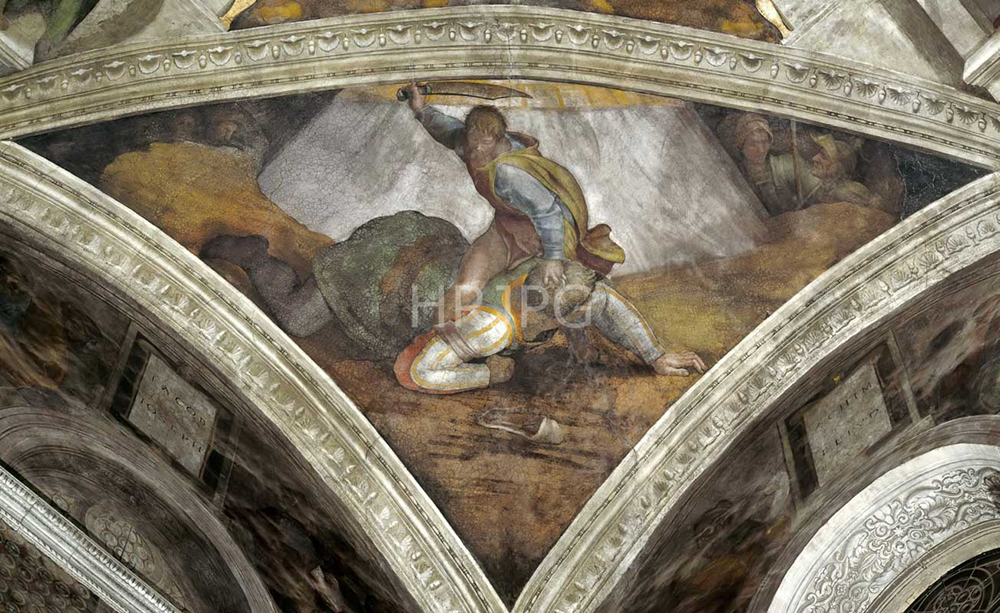
The corner spandrel depicting David and Goliath is a powerful and dramatic narrative fresco on the Sistine Chapel ceiling, illustrating the biblical victory of the young David over the Philistine giant. Michelangelo captures the climactic moment of the struggle, showing David straddling the prone figure of Goliath and preparing to strike the final blow with his sword. The composition is expertly adapted to the challenging triangular architectural space, utilizing extreme foreshortening and a compact arrangement of figures to emphasize the physical weight and the heroic nature of the victory. This work serves as a profound allegory for the triumph of divine will and intellectual courage over brute physical strength, a theme that resonated deeply with the political and religious identity of Renaissance Florence and the Papacy.
The technical execution of "David and Goliath" showcases Michelangelo’s ability to represent intense physical struggle through the heroic nude. David is modeled with a lithe, muscular anatomy that conveys both agility and power, while Goliath’s massive form represents the crude, earthbound nature of the defeated tyrant. Michelangelo utilize strong "chiaroscuro" to project the figures forward, creating a powerful sense of three-dimensional volume amidst the dark, claustrophobic atmosphere of the battlefield. The focused expression on David’s face and the rhythmic motion of his arms convey a state of divine resolve, mirroring the spiritual alertedness found in the surrounding Prophets and Sibyls. The use of muted, earthy tones for the foreground ensures that the focus remains on the anatomical and narrative drama of the two protagonists.
Historically, the subject of David was of immense significance to Michelangelo, who had already completed his colossal marble "David" in Florence. In the context of the Sistine Chapel, the fresco prefigures the victory of the Church over its enemies and the ultimate triumph of the soul over sin. Michelangelo’s interpretation avoids the static, celebratory poses of earlier traditions, choosing instead a moment of raw, visceral action that underscores the physical cost of the heroic act. Technically, the work demonstrates the artist’s early mastery of complex group compositions within restricted boundaries. It remains a masterpiece of dramatic economy and profound human relevance, standing as an enduring testament to Michelangelo’s unique vision of the heroic individual in sacred history and his status as the supreme master of the human form across the cities of Europe.