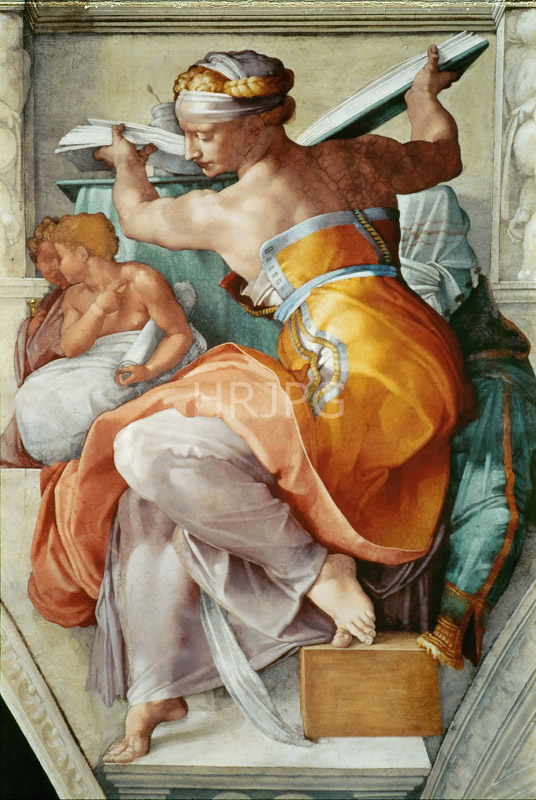
The Libyan Sibyl is widely recognized as one of the peak achievements of Michelangelo’s work on the Sistine Chapel ceiling, personifying the ancient African priestess who prophesied the coming of Christ. Michelangelo depicts her in a magnificent, spiraling pose (the "figura serpentinata") as she reaches back to put down her book of prophecies onto a pedestal. This figure captures the perfect synthesis of physical strength and supreme aesthetic grace, showcasing the artist’s unrivaled mastery of human anatomy and rhythmic harmony. The Sibyl’s form is both monumental and delicate, rendered with vibrant colors—particularly the luminous yellow and orange of her garments—that make her one of the most radiant elements of the entire decorative program.
The technical execution of the Libyan Sibyl is a masterclass in the application of the fresco medium. Michelangelo used a male model for the initial anatomical studies to achieve a heroic muscularity, yet he successfully translated this into a figure of divine feminine authority and idealized beauty. The play of light across her skin gives her a living quality, while the intricate modeling of her back and torso emphasizes the sculptural volume that is quintessentially Michelangelesque. Her focused and visionary expression conveys a state of spiritual alertness, as if she is still processing the divine revelation she has just recorded. The two cherubs at her feet provide a sense of narrative depth and scale, highlighting the colossal proportions of the prophetess within the architectural niche of the vault.
Historically, the Libyan Sibyl represents the pagan world’s anticipation of a savior, serving as a vital prophetic bridge between classical antiquity and the Christian era. Her placement near the scenes of creation reinforces her role as a witness to the divine order of the universe. This work has inspired countless artists for its perfect proportions and its ability to communicate the ephemeral nature of divine inspiration through a visual language of peak elegance and technical refinement. It remains a cornerstone of Western art history, standing as a testament to Michelangelo’s unique creative genius and his belief that the human form is the ultimate vessel for expressing the majesty of the divine spirit. The Libyan Sibyl secures her place as one of the most enduring and beloved images of the prophetic spirit in the history of art.