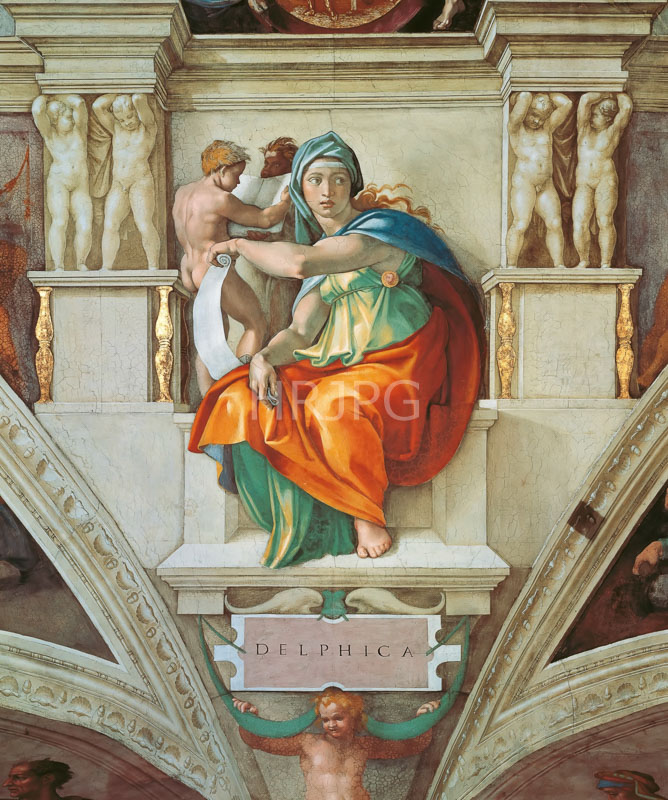
The Delphic Sibyl is widely considered one of the most beautiful and evocative figures on the Sistine Chapel ceiling. Representing the ancient Greek prophetess from Delphi, she is depicted in a moment of intense spiritual alertness, her wide, visionary eyes turned as if startled by a divine revelation. Michelangelo renders her with an idealized beauty that synthesizes classical grace with High Renaissance power. She holds a long scroll, a symbol of her prophetic knowledge, while her flowing hair and mantle suggest a gentle, celestial wind. The composition is characterized by a stable, yet dynamic pose, where her torso turns toward the viewer while her gaze is fixed on an unseen, transcendent reality, embodying the perfect balance between physical presence and spiritual focus.
The modeling of the Sibyl is a masterclass in Michelangelos sculptural approach to painting. Her features are carved with a startling clarity, and the heavy drapery of her orange and blue robes is rendered with deep, articulated folds that emphasize her monumental volume. The use of vibrant, saturated colors makes her one of the most striking elements of the ceiling, standing out against the architectural framework. The two youthful cherubs behind her suggest the divine inspiration that guides her prophecies, providing a sense of depth and narrative context. Michelangelo utilizes a sophisticated chiaroscuro to give her skin a luminous quality, making her appear as a living presence within the sacred space of the chapel.
Historically, the inclusion of pagan Sibyls alongside Hebrew prophets reflects the Renaissance humanists belief in the universal quest for divine truth. The Delphic Sibyl serves as a bridge between the classical past and the Christian era, foreshadowing the coming of the Messiah. This work has inspired countless artists for its perfect proportions and the profound sense of dignity it imbues into the female form. It remains a cornerstone of Michelangelos artistic legacy, demonstrating his ability to capture the ephemeral nature of divine inspiration through a visual language of peak elegance and technical refinement. As part of the first phase of the ceiling project, it showcases the artists early mastery of the fresco medium and his commitment to the search for a perfect synthesis of beauty and power.