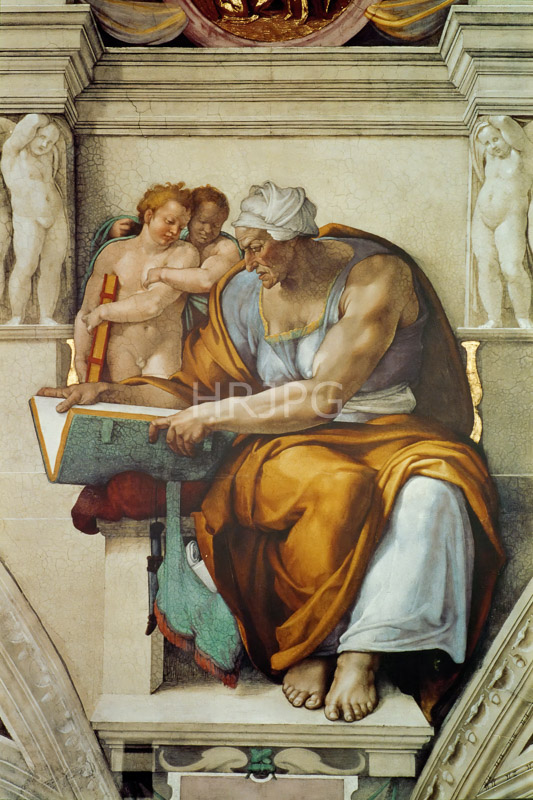
The Cumaean Sibyl is portrayed by Michelangelo as a massive and aged figure, emphasizing the immense weight of ancient knowledge and the passage of time. According to legend, the Sibyl was granted longevity but not eternal youth, and in this fresco, she is shown as a powerful, muscular woman with deeply lined features and a focused, scholarly gesture. She is intently reading a large book, her massive arms and heavy drapery conveying a sense of monumental stability and intellectual authority. This depiction is a radical departure from the youthful grace of the Delphic Sibyl, illustrating Michelangelos profound interest in the dignity and expressive potential of old age and the physical presence of spiritual wisdom within the chapel setting.
The technical execution of the Cumaean Sibyl showcases Michelangelos mastery of volume and foreshortening. Despite her seated pose, her figure possesses an extraordinary sense of weight and three-dimensional space. The intricate folds of her garment, rendered in earthy tones of green and orange, are modeled with strong chiaroscuro to emphasize the sculptural quality of her form. Her face, though aged, radiates a formidable energy, her focused gaze suggesting a deep immersion in divine prophecy. The two cherubs peering over her shoulder add a touch of intimacy and narrative movement, their smaller scale highlighting the colossal proportions of the prophetess. Michelangelo uses the surrounding architectural elements to anchor her presence, making her appear as a permanent, immovable pillar of ancient wisdom.
In the context of the Sistine ceiling, the Cumaean Sibyl represents the pagan world’s anticipation of a savior. Her presence reinforces the universal nature of the divine plan, bridging the gap between classical antiquity and biblical history. Michelangelo’s choice to render her with such muscularity and physical power reflects his belief that the human soul, even when burdened by age, remains a heroic and divine vessel. This work has been admired for centuries for its psychological depth and its uncompromising realism. It stands as a testament to the artists ability to transform a traditional religious subject into a profound meditation on the human condition, the endurance of knowledge, and the majestic power of the prophetic spirit.