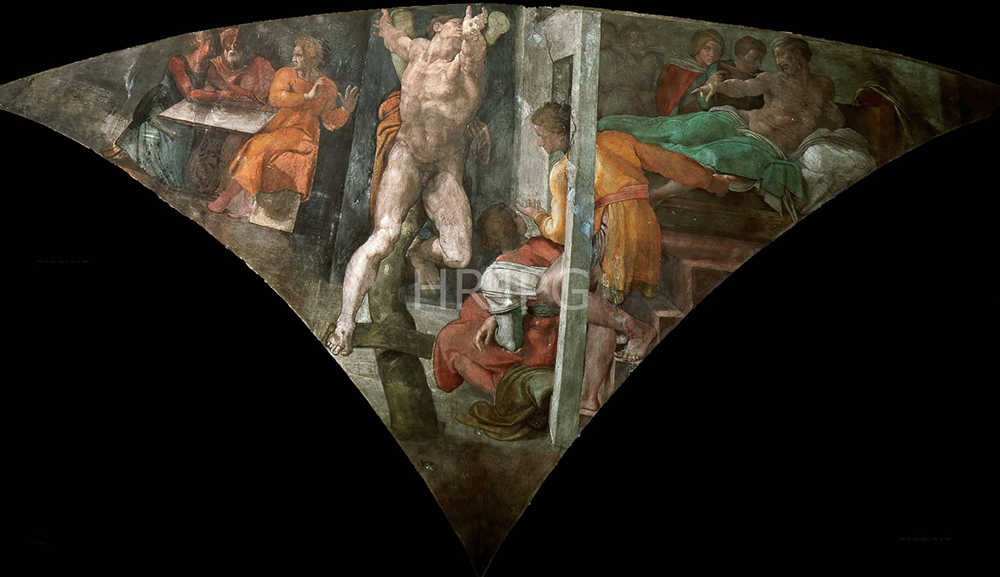
The Punishment of Haman is one of the four monumental corner spandrels of the Sistine Chapel ceiling, depicting the dramatic climax of the biblical Book of Esther. Michelangelo captures the moment of divine justice where the villain Haman, having plotted against the Jewish people, is himself executed on the very gallows he prepared for Mordecai. The composition is a daring exploration of anatomical contortion and extreme foreshortening, as Haman is shown crucified in a complex, three-dimensional pose that seems to burst out of the triangular architectural space. This work reflects Michelangelo’s late stylistic shift on the ceiling toward more expressive, dynamic, and psychologically charged figure types, anticipating the turbulence of the later Mannerist era.
The scene is divided into several narrative layers that move from the background to the foreground. In the distant left, King Ahasuerus is shown listening to Esther’s plea, while on the right, the triumph of Mordecai is suggested. However, the central focus remains the agonizing figure of Haman. Michelangelo utilizes a brilliant and varied color palette, contrasting the vibrant robes of the onlookers with the bruised, shadowed flesh of the condemned man. The "figura serpentinata"—the twisting, spiraling motion of Haman’s body—serves as a masterclass in representing physical and moral struggle. The use of "chiaroscuro" is exceptionally strong here, casting deep shadows that emphasize the physical weight of the execution and the dark, claustrophobic atmosphere of the event. The figures surrounding Haman react with a mixture of awe and stern resolve, highlighting the gravity of the divine intervention.
Historically, this fresco is significant for its theological and political resonance, symbolizing the protection of the faithful and the inevitable fall of the wicked. Michelangelo’s decision to depict Hamans punishment through a crucifixion-like pose adds a layer of complex irony and tension, linking the Old Testament narrative to the central themes of sacrifice and judgment found in the New Testament. Technically, the work showcases the artist’s supreme mastery of the fresco medium under the most challenging physical conditions. It remains a masterpiece of dramatic storytelling and formal innovation, standing as a testament to Michelangelo’s ability to transform a gruesome scene of execution into a profound meditation on justice, power, and the terrifying majesty of the divine will.