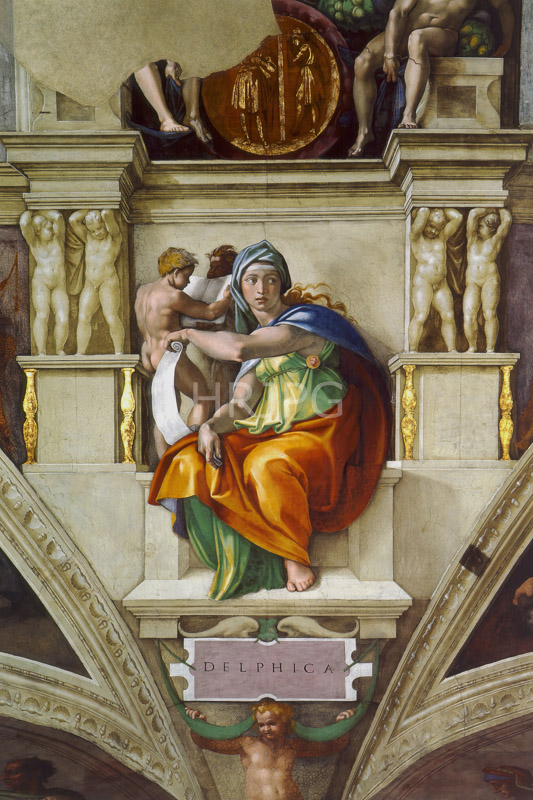
The Delphic Sibyl is one of the most iconic and beloved figures on the Sistine Chapel ceiling, personifying the ancient Greek prophetess of the Oracle of Apollo. Michelangelo depicts her as a youthful and visionary woman, her wide eyes turned in a state of sudden, divine realization as she listens to an unseen celestial voice. She holds a long scroll of prophecy, her body positioned in a stable yet dynamic pose that conveys a sense of spiritual alertness and intellectual dignity. Unlike the more muscular and aged Sibyls on the ceiling, the Delphic Sibyl possesses a lyrical grace and idealized beauty that reflects the early High Renaissance search for a perfect synthesis of the physical and the spiritual.
The technical execution of this figure is a masterclass in the application of "sfumato" and "chiaroscuro." Michelangelo uses soft transitions between light and shadow to model her features, giving her skin a luminous, porcelain-like quality. Her flowing hair and the heavy, rhythmic folds of her blue and orange mantle suggest a gentle, divine wind that unifies the figure with the surrounding atmosphere. Behind her, two youthful cherubs provide a sense of narrative depth, their expressions reflecting the weight of the prophetic message. The Sibyl’s presence is anchored by the architectural niche, yet her gaze seems to transcend the physical boundaries of the chapel, inviting the viewer into a state of contemplative wonder. The clarity of the drawing and the vibrancy of the colors make her a focal point of the first half of the ceiling.
Historically, the inclusion of the Delphic Sibyl underscores the Renaissance humanists’ belief that divine truth was revealed to all nations before the birth of Christ. She serves as a vital link between the classical past and the Christian present, representing the intuitive power of the soul to perceive the divine plan. This work has been admired for centuries for its psychological depth and its ability to communicate the ephemeral nature of inspiration through a visual language of peak elegance. As a highlight of Michelangelo’s early work on the ceiling, it remains a testament to his status as a master who could capture the deepest mysteries of faith through the medium of the human form, securing its place as one of the most enduring images of the prophetic spirit in Western art.