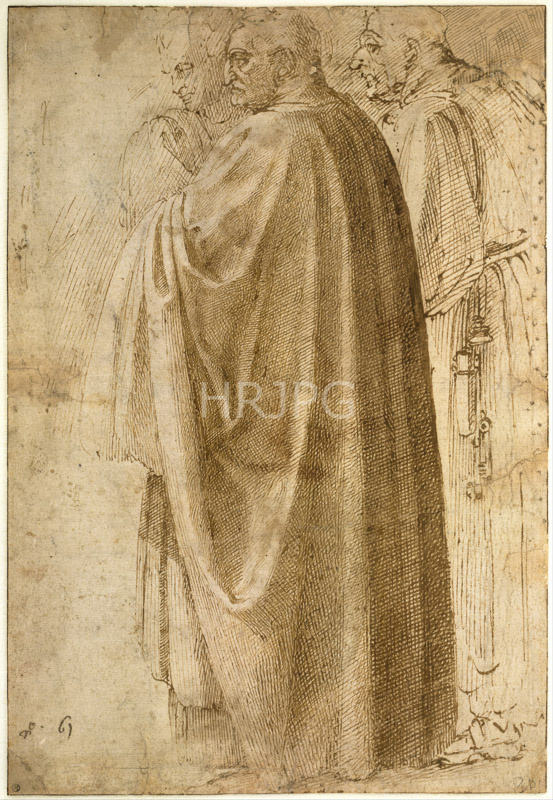
This early pen and ink drawing, "Three Standing Men in Wide Cloaks," is a cornerstone for understanding the artistic origins of the young Michelangelo. Created during his initial training in Florence, it is a direct study after the figures in Masaccio’s revolutionary fresco "Sagra del Carmine" (now lost). The work reveals Michelangelo’s deep respect for the Florentine tradition and his effort to master the weight, volume, and gravity of monumental draped figures that characterized the works of his predecessors. In this sketch, the young artist focuses on the rhythmic flow of the heavy cloaks, using dense, disciplined cross-hatching to create a powerful sense of three-dimensional form and physical presence that would become his lifelong signature.
The composition is characterized by a stable, architectural quality, with the three figures grouped in a way that suggests a solemn and dignified conversation. Michelangelo ignores the individual facial features to focus almost entirely on the structural logic of the drapery and the underlying skeletal weight of the men. This analytical approach demonstrates his budding genius for sculptural modeling, even when working with pen on paper. The use of a sharp, precise line reflects the influence of the Ghirlandaio workshop, where he began his apprenticeship, yet the extraordinary sense of monumentality already distinguishes him from his contemporaries. The drawing serves as a bridge between the linear precision of the 15th century and the atmospheric, emotionally charged style of the High Renaissance.
Historically, this work is significant as evidence of Michelangelo’s self-education through the "imitation of nature" and the copying of great masters. By engaging with Masaccio’s innovations in spatial organization and figure weight, the young artist laid the foundation for his own monumental achievements on the Sistine ceiling and in his sculptural masterpieces. Today, held in the Albertina in Vienna or the Louvre, this drawing remains one of the most admired examples of early Renaissance academic practice. It stands as a testament to Michelangelo’s relentless work ethic and his unique ability to see the heroic potential in even the simplest draped figure. It provides an invaluable window into the creative process of a genius who would eventually redefine the boundaries of Western art through his uncompromising pursuit of formal and spiritual truth.