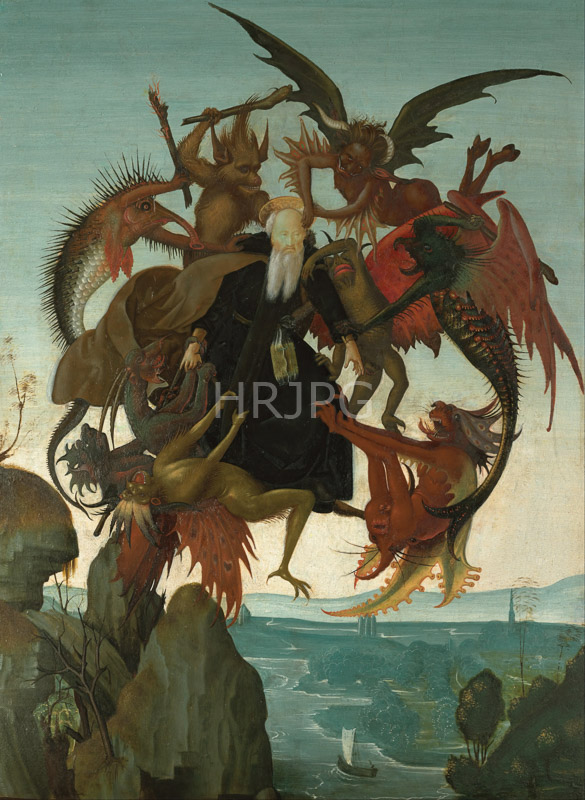
The Torment of Saint Anthony is widely recognized by modern scholars as the earliest known painting by Michelangelo, executed when he was only twelve or thirteen years old. Based on a celebrated engraving by the German master Martin Schongauer, this small tempera and oil panel depicts the desert saint being pulled into the air by a swarm of grotesque, multi-colored demons. Michelangelo’s version is far more than a mere copy; it demonstrates a remarkable leap in color, texture, and psychological intensity. The young artist added a personalized landscape featuring the Arno river valley and infused the demons with fish-like scales and vibrant hues, reflecting his early and meticulous study of nature at the local fish markets. This work serves as a startling debut of a genius who would later dominate the High Renaissance.
The composition is a swirling vortex of movement and physical struggle, with the serene and stoic figure of Saint Anthony forming the stable center of the chaotic assault. Michelangelo utilizes a sophisticated sense of rhythmic harmony to lead the viewer’s eye through the overlapping forms of the monsters. The use of light is particularly effective, illuminating the saint’s pale, translucent skin and the shimmering surfaces of the demons’ bodies, creating a powerful sense of three-dimensional volume. Unlike the monochromatic original print, Michelangelo’s painting explores the emotional and sensory power of color to enhance the narrative of spiritual trial. The detailed rendering of the Saint’s heavy robes and the craggy, atmospheric landscape in the background hints at the monumental style that would characterize his later fresco masterpieces.
Historically, the "Torment of Saint Anthony" was documented by Michelangelo’s biographers, Vasari and Condivi, as a testament to his precocious talent and his ability to surpass his models. The painting was lost to history for centuries before its sensational rediscovery and acquisition by the Kimbell Art Museum in 2009. It remains a vital object of study for understanding the synthesis of Northern European precision and Italian monumentalism that occurred in Florence at the end of the 15th century. This work stands as a hauntingly beautiful icon of the young artist’s creative ambition, representing the very moment when the boy apprentice began to transform into the "Divine Michelangelo" who would eventually capture the entire spectrum of human and divine experience.