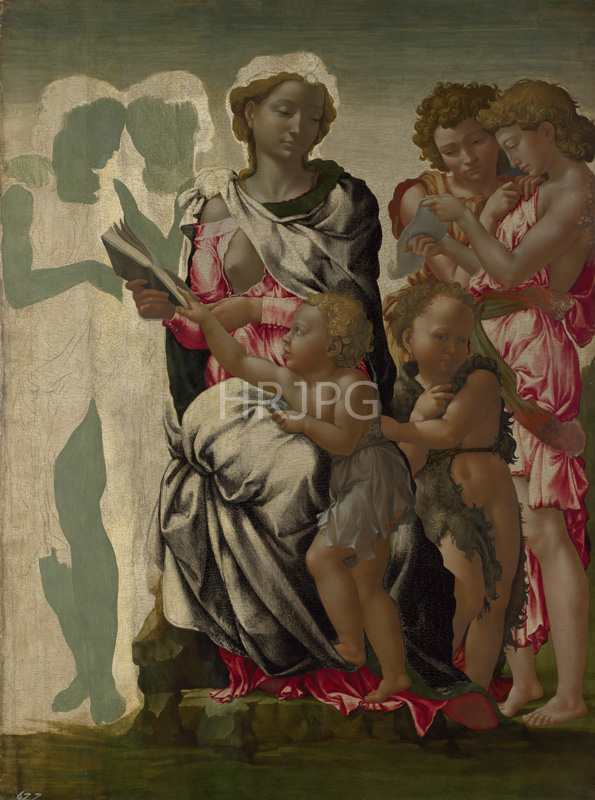
The Manchester Madonna, also known as the "Madonna and Child with Saint John and Angels," is a rare and profound example of Michelangelo’s early foray into panel painting. Though left unfinished, the work provides an invaluable window into the artists creative process and his sculptural approach to the medium of tempera. The Virgin Mary is shown seated in a stable, pyramidal composition, holding a book of prophecy as the infant Christ and the young Saint John the Baptist interact beside her. The background features a group of androgynous, curly-haired angels, some of whom are rendered only in green underpainting ("verdaccio"). This masterpiece demonstrates Michelangelo’s unique ability to combine domestic maternal tenderness with a sense of monumental, divine weight that was unprecedented in devotional art of the 1490s.
The figure of the Virgin is modeled with a startling clarity and solidity, her face possessing the serene, noble beauty found in Michelangelo’s early marble "Pieta." The use of "chiaroscuro" creates a powerful sense of three-dimensional volume, making the characters appear to surge out of the picture plane into the viewer’s immediate space. The infant Christ is rendered with a remarkable naturalism, his chubby, realistic anatomy reflecting the artists rigorous scientific studies of human growth. The interaction between the figures is characterized by a quiet, rhythmic harmony, where every gesture serves the overall sacred narrative. The unfinished state of the angels allows us to appreciate the meticulous layering of pigments and the artists focus on structural integrity over superficial decorative detail, highlighting his belief that the human form is the primary site of peak artistic achievement.
Historically, the "Manchester Madonna" reflects the influence of the Florentine workshop tradition and the intellectual climate of the Medici circle, where the "beautiful" was inextricably linked to the "good." The work has been the subject of intense study since it was first exhibited at the Manchester Art Treasures Exhibition in 1857, which gave it its popular name. Now a centerpiece of the National Gallery in London, it remains a vital document of the young Michelangelo’s status as a master who could bridge the gap between the linear precision of the 15th century and the monumental depth of the High Renaissance. It stands as a hauntingly beautiful reminder of the power of the "non-finito" (unfinished) state to communicate the deepest mysteries of faith and the restless creative spirit of the world's most celebrated artist.