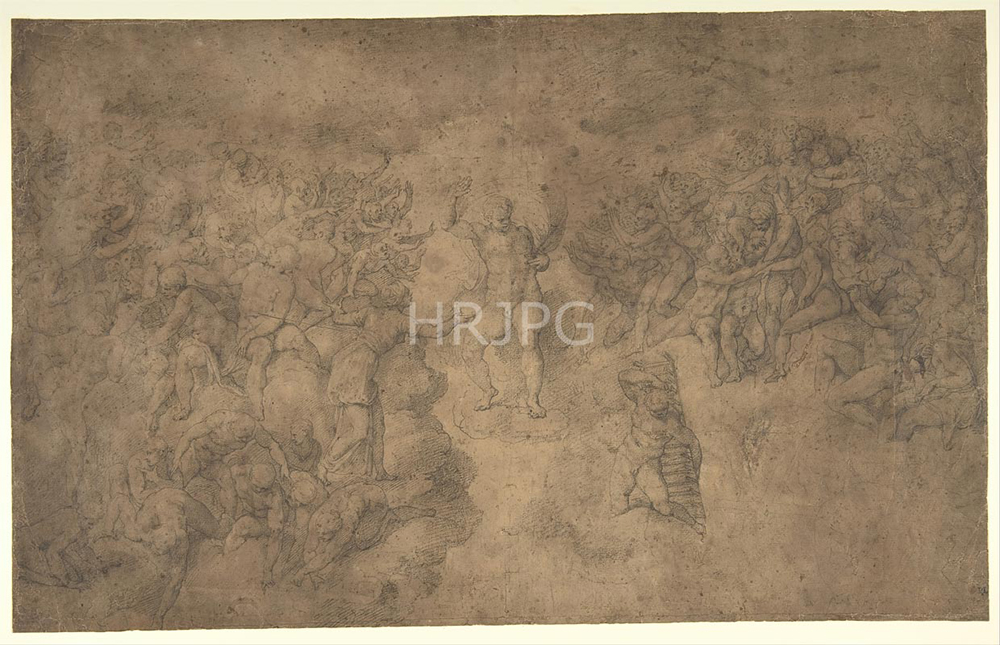
This compositional sketch provides a critical look into the early planning stages for the monumental altar wall fresco of the Sistine Chapel, "The Last Judgment." Attributed to the School of Michelangelo, likely a close associate or pupil working from the masters direct designs, the drawing captures the overall rhythmic flow and the swirling vortex of figures that define the final masterpiece. Michelangelo’s vision for the judgment was a radical departure from traditional, tiered representations; instead, he conceived a unified, chaotic space where souls are either ascended by divine grace or dragged down by their own sins. This sketch highlights the primary focus on Christ the Judge at the center, surrounded by a dense, circular arrangement of saints and martyrs that creates a sense of cosmic motion.
The technical execution of the sketch, likely using pen and ink with light washes, emphasizes the "motions of the mind" and the development of figure groupings. It reveals the artists struggle to organize hundreds of muscular, contorted bodies into a legible and emotionally charged narrative. The figures are sketched with a sense of urgency, focusing on silhouettes and broad spatial relationships rather than fine anatomical detail. This preparatory stage was essential for managing the vast scale of the altar wall, which had to be viewed from a distance while maintaining its psychological impact. The sketch also hints at the influence of Dante’s "Divine Comedy," particularly in the depiction of Charon’s boat and the infernal regions in the lower section, reflecting the deep spiritual and literary undercurrents of the Counter-Reformation period.
Historically, this drawing is significant for its role in the evolution of the High Renaissance into the Mannerist style. It showcases the transition from the stable, balanced compositions of Michelangelo’s earlier ceiling frescoes to a more turbulent, expressive, and emotionally raw visual language. By studying this sketch, scholars gain insight into the collaborative nature of Renaissance workshops and the immense intellectual effort required to realize such a colossal theological program. It remains a vital document for understanding the sheer ambition of the "Last Judgment" project and Michelangelo’s enduring legacy as a visionary who could bridge the gap between human anatomy and divine mystery, creating a vision of the end of time that continues to haunt and inspire viewers centuries later.