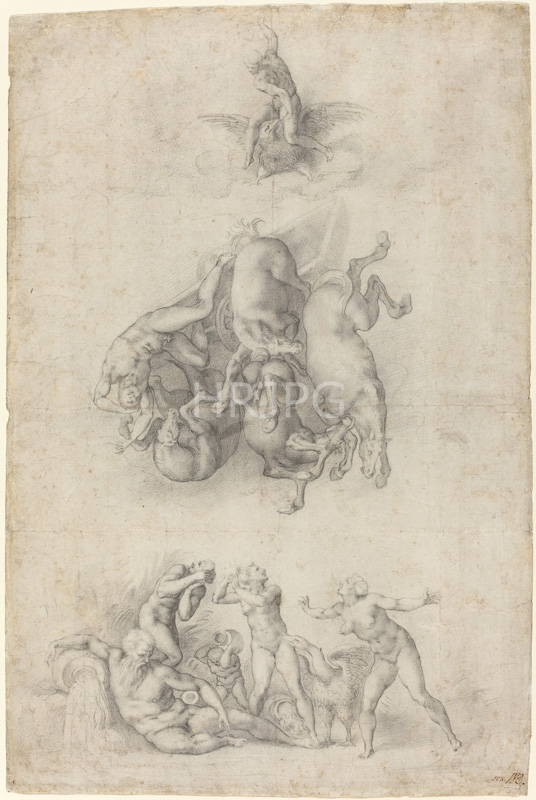
"The Fall of Phaeton" is one of Michelangelo’s most famous "presentation drawings," created as a personal gift for his young friend Tommaso dei Cavalieri. This black chalk drawing is a masterpiece of mythological narrative and anatomical complexity, depicting the tragic moment when Zeus strikes down the sun-god’s son, Phaeton, with a thunderbolt for his hubris. Michelangelo organizes the scene into three distinct vertical tiers: Zeus commanding from the heavens at the top, the crashing chariot and plunging horses in the center, and the mourning sisters of Phaeton (the Heliades) alongside the river god Eridanus at the bottom. The work is a profound meditation on human ambition and divine retribution, rendered with the rhythmic elegance and muscular tension that define the artists late stylistic maturity.
The central group of Phaeton and his horses is a tour de force of foreshortening and dynamic motion. Michelangelo captures the raw energy of the animals in mid-air, their limbs contorted in a state of panic and descent. The figure of Phaeton, falling headfirst, serves as the ultimate anatomical study of a body in extreme physical trauma. In the lower section, the transformation of the Heliades into poplar trees is suggested through their elongated, expressive poses, conveying a deep sense of psychological grief. The modeling of the figures using delicate hatching and rubbing of the black chalk creates a sense of three-dimensional volume and lifelike skin texture that rivals the solidity of stone. This technical refinement reflects the drawings purpose as a highly finished work of art intended for private contemplation rather than as a preparatory study for a painting.
Historically, this drawing represents the deep platonic and spiritual bond between Michelangelo and Cavalieri, often interpreted through the lens of Neo-Platonic philosophy where the "fall" represents the soul’s struggle with earthly desires. It showcases Michelangelo’s ability to imbue classical mythology with a modern sense of existential weight and emotional depth. Technically, the "Fall of Phaeton" set a new standard for finished drawings in the Renaissance, influencing generations of artists who sought to master the complexities of multi-figure compositions and extreme physical movement. Now held in the British Museum (or the Royal Collection at Windsor), it remains an iconic image of the High Renaissance, demonstrating why Michelangelo was considered the supreme master of the human form as a vessel for the most profound mysteries of the human spirit.