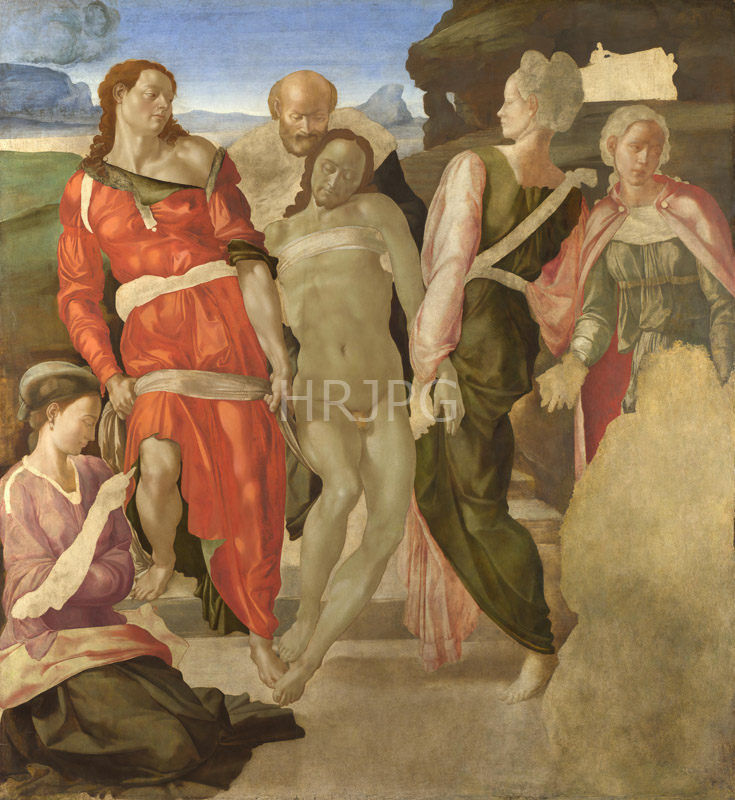
"The Entombment" is a rare and enigmatic panel painting by the young Michelangelo, left in an intriguing state of "non-finito" (unfinished). Now a centerpiece of the National Gallery in London, it depicts the body of Christ being carried toward his tomb, supported by Joseph of Arimathea and likely Saint John the Evangelist and Mary Magdalene. The work is significant for its stylistic link to the contemporary marble "Pieta" in Rome, showcasing the artists simultaneous exploration of the human form in both painting and sculpture. The composition is characterized by its powerful verticality and the immense physical effort required to carry the heavy, limp body of Christ, reflecting Michelangelo’s obsession with anatomical weight and gravitational tension.
The figure of Christ is modeled with a startling, pale luminosity, his muscular yet lifeless anatomy serving as the focal point of the spiritual drama. Michelangelo utilizes a sophisticated sense of rhythmic harmony to lead the viewer’s eye through the intertwined limbs of the supporting figures. The missing figure on the right, intended to be the Virgin Mary, leaves a haunting void that emphasizes the tragic isolation of the event. The technical execution involves a transition from the traditional egg tempera method toward the more versatile oil medium, allowing for the soft transitions and deep shadows that create a sense of monumental volume. The craggy, simplified landscape in the background provides a somber setting that enhances the psychological weight of the sacred narrative without distracting from the central figures.
Historically, the "Entombment" was long a subject of debate regarding its attribution, but modern technical analysis has confirmed Michelangelo’s authorship beyond doubt. It represents a pivotal moment in Florentine art where the linear precision of the late 15th century began to merge with the monumental depth of the High Renaissance. The unfinished state provides a masterclass in the artists creative process, revealing the meticulous underdrawing and the careful layering of pigments. By engaging with this work, viewers gain insight into the restless spirit of a young genius who was already redefining the boundaries of religious art. It remains a profound meditation on mortality, sacrifice, and the physical reality of the divine, standing as a hauntingly beautiful icon of Michelangelo’s early creative ambition and his unique vision of the human body as a sacred vessel.