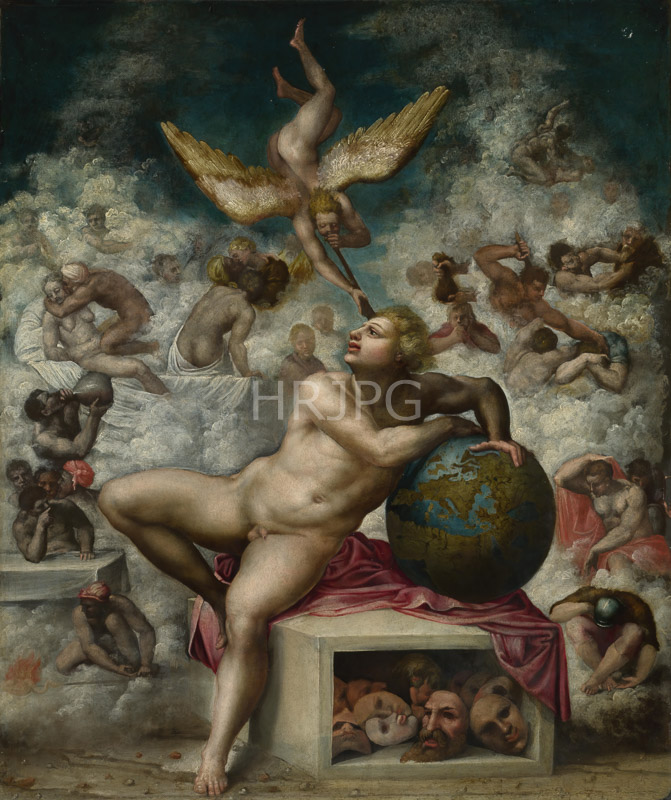
"The Dream of Human Life" (Il Sogno) is a fascinating allegorical composition based on a celebrated lost drawing by Michelangelo. This version, likely executed by a talented contemporary or follower such as Marcello Venusti, captures the complex moral and philosophical themes of the original design. The painting depicts a beautiful, reclining youth who is startled awake by the sounding of a trumpet by a descending angel. Surrounding the youth are a swirling vortex of grotesque masks and scenes of worldly sins—representing the illusions and vices of earthly existence. The work serves as a profound Neo-Platonic allegory for the awakening of the human soul from the "dream" of material life toward a state of spiritual clarity and divine truth.
The youth sits upon a large stone sphere, a traditional symbol of the instability of fortune and the material world. Michelangelo’s original design was noted for its use of "sfumato" and rhythmic, spiraling figures that unify the diverse elements of the allegory. In this painted version, the artist emphasizes the physical beauty of the youth, whose muscular yet graceful anatomy reflects the High Renaissance ideal of the human body as a vessel for the spirit. The contrast between the idealized central figure and the unsettling, shadowed masks creates a powerful visual drama that highlights the struggle between vice and virtue. The angel, descending with a dynamic sense of motion, represents the divine intervention required for spiritual enlightenment, a theme that resonated deeply with the religious anxieties of the mid-16th century.
Historically, "The Dream of Human Life" was one of Michelangelo’s most sought-after compositions, disseminated through numerous copies and prints. It reflects the artists engagement with the intellectual circles of Rome and his interest in moralizing themes that transcended traditional biblical narratives. This painting provides an invaluable record of a lost masterpiece, showcasing how Michelangelo’s ideas continued to influence the development of Mannerist and Baroque art. Technically, the works focus on complex multi-figure arrangements and psychological tension set a standard for allegorical painting. It remains a vital subject of study for its unique synthesis of classical philosophy and Christian morality, standing as a testament to Michelangelo’s enduring power to challenge and inspire the human intellect through the medium of the visionary image.