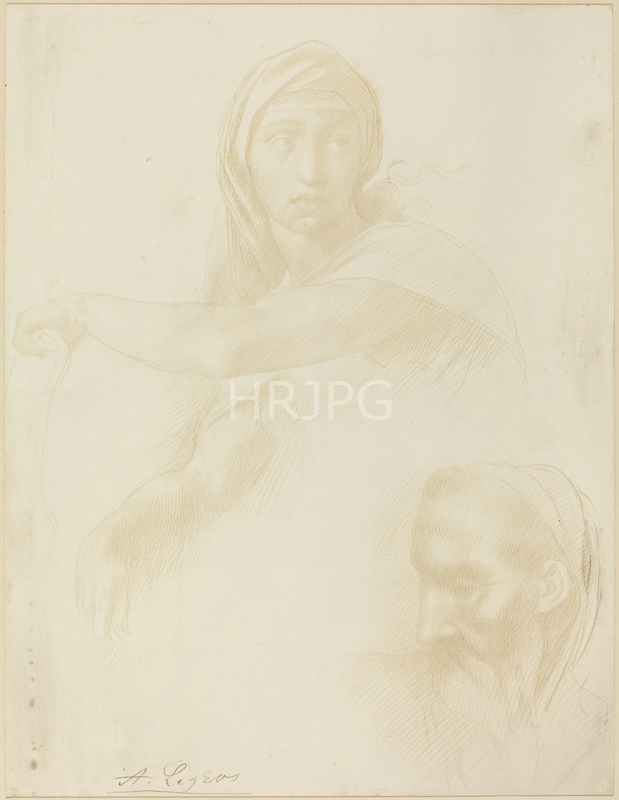
This late 19th-century etching and drawing by the French-British artist Alphonse Legros is a faithful and highly skilled study after the "Delphic Sibyl" from Michelangelo’s Sistine Chapel ceiling. Legros, a key figure in the "Etching Revival" and a professor at the Slade School of Art, utilized this work to engage with the monumental legacy of the High Renaissance. The study captures the visionary gaze and the idealized features of the original prophetess, focusing on the rhythmic flow of her drapery and the sculptural volume of her form. This work serves as a testament to the enduring influence of Michelangelo’s figure style on modern academic drawing traditions and the continuous reception of the Sistine masterpieces by later generations of European artists.
Legros employs a sophisticated graphic technique, using fine lines and controlled tonal values to translate the colors of the fresco into a monochromatic medium. He successfully preserves the "terribilità" and the serene dignity of Michelangelo’s vision, emphasizing the intellectual focus of the Sibyl. The use of a sharp, precise line reflects Legros’s own commitment to the "pure" academic style, while the subtle shading creates a powerful sense of three-dimensional space and physical presence. This study was likely intended as a teaching tool, demonstrating how the masters of the past could still provide essential lessons in proportion, composition, and emotional expression. It highlights the role of the museum and the print room as the ultimate "school of the world" for the developing modern artist.
Historically, this work reflects the 19th-century fascination with the "Old Masters" and the search for a classical foundation amidst the rapid changes of the industrial age. Legros’s focus on Michelangelo underscores the belief that the human form remains the primary site of artistic and spiritual significance. Technically, the study is a masterpiece of graphic translation, showcasing the artists ability to capture the ephemeral qualities of divine inspiration through a rigorous and disciplined visual language. It remains a vital piece of the Renaissance reception history, demonstrating that Michelangelo’s "Delphic Sibyl" continues to speak across the centuries, providing a bridge between the sacred art of the 16th century and the secular academic traditions of the late 19th century. It stands as a hauntingly beautiful reminder of the enduring power of the classical ideal.