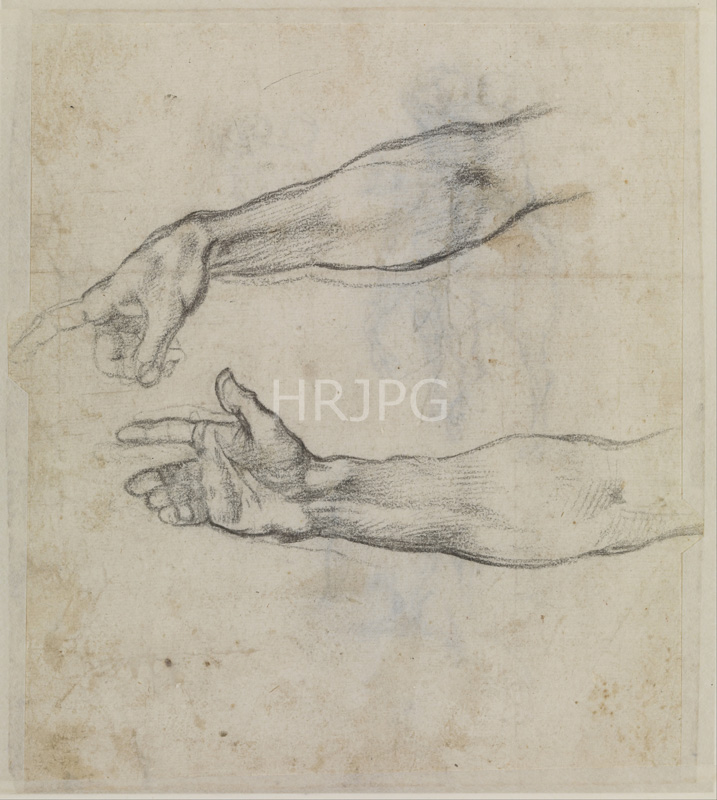
These meticulous chalk studies of an outstretched arm and hand are essential preparatory works for one of the early panels on the Sistine Chapel ceiling, specifically the "Drunkenness of Noah." Michelangelo utilizes the medium of red and black chalk to conduct a rigorous scientific investigation into human anatomy, focusing on the play of light over muscles, tendons, and bone to achieve perfect naturalism. These studies demonstrate the artists unique creative process, where even the smallest narrative detail was subjected to an intense intellectual and physical scrutiny before being translated onto the grand scale of the fresco. The work reflects the High Renaissance belief that a profound understanding of the internal structure of the body was the only path to representing the external beauty and spiritual potential of humanity.
The drawing showcases Michelangelo’s unrivaled mastery of the "non-finito" (unfinished) technique, where some areas are rendered with microscopic detail while others remain as energetic outlines. He focuses on the tension of the forearm and the delicate positioning of the fingers as they interact with an invisible object or figure. The use of hatching and subtle smudging creates a powerful sense of three-dimensional volume and lifelike skin texture. These studies were likely conducted from a live male model, as evidenced by the muscularity and the realistic ripple of the flesh. By isolating the arm, Michelangelo could perfect the complex spatial arrangement and the foreshortening required for the ceiling panel, ensuring that the final work would possess a monumental dignity and a convincing physical presence when viewed from the chapel floor.
Historically, these anatomical studies are critical for understanding the sheer scale and complexity of the Sistine project. They reveal Michelangelo as a restless genius who never relied on generic formulas, but instead sought a direct and uncompromising engagement with the "imitation of nature." Now held in the Royal Collection at Windsor or the British Museum, this drawing remains a vital object of study for artists and scholars alike. It stands as a testament to the artists belief that the human body is a sacred vessel for expressing the divine plan. It serves as a hauntingly beautiful reminder of the immense intellectual effort and physical discipline required to create a masterpiece that would revolutionize Western art, securing Michelangelo’s status as the supreme master of the human form across the cities of Europe.