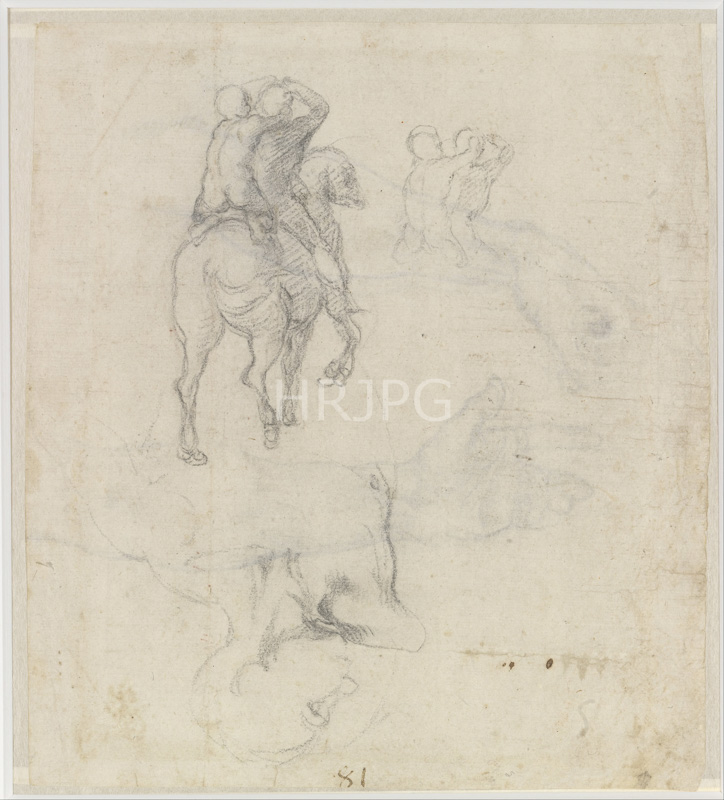
These dynamic pen and ink studies, depicting a rearing horse and two nude riders, are essential documents related to Michelangelo’s lost monumental project for the Palazzo Vecchio in Florence: the "Battle of Cascina." The drawing captures a state of frantic energy and physical struggle, providing a masterclass in the representation of both human and animal anatomy in extreme motion. Michelangelo utilize vigorous hatching and rhythmic outlines to define the powerful muscular structure of the horse and the contorted poses of the riders, reflecting his obsession with the human form as the primary vehicle for artistic expression. This work represents a pivotal moment in Florentine art where the scientific study of movement and heroic idealism reached a peak of synthesis.
The study showcases the artists ability to coordinate complex spatial arrangements and the interaction between figures. The rearing horse, viewed from a radical foreshortened perspective, creates a powerful sense of three-dimensional depth and raw power. The two riders, caught in a desperate struggle, serve as the ultimate anatomical study of bodies under stress. Michelangelo ignores the individual facial features to focus entirely on the structural logic of the figures and the underlying skeletal weight. The use of pen and ink allowed him to achieve a range of expressive lines, from delicate, fine strokes to intense, dark markings that emphasize the physical urgency of the battle alarm. Even as a preparatory sketch, the work possesses a monumental dignity, demonstrating Michelangelo’s ability to imbue a single anatomical study with the energy of an entire epic narrative.
Historically, these studies were highly influential, serving as a "school of the world" for younger artists who flocked to copy Michelangelo’s cartoon before its destruction. They reveal the transition from the stable, classical poses of his early career to the more expressive and contorted movements that would define his later work on the Sistine ceiling. Today, held in the Ashmolean Museum or the British Museum, this drawing remains a vital object of study for those seeking to understand the foundations of Michelangelo’s figure style. It stands as a testament to the artists relentless search for anatomical perfection and his unique ability to capture the ephemeral qualities of human thought and frantic physical action within a singular, crystalline visual space, securing his status as the supreme master of form in the High Renaissance.