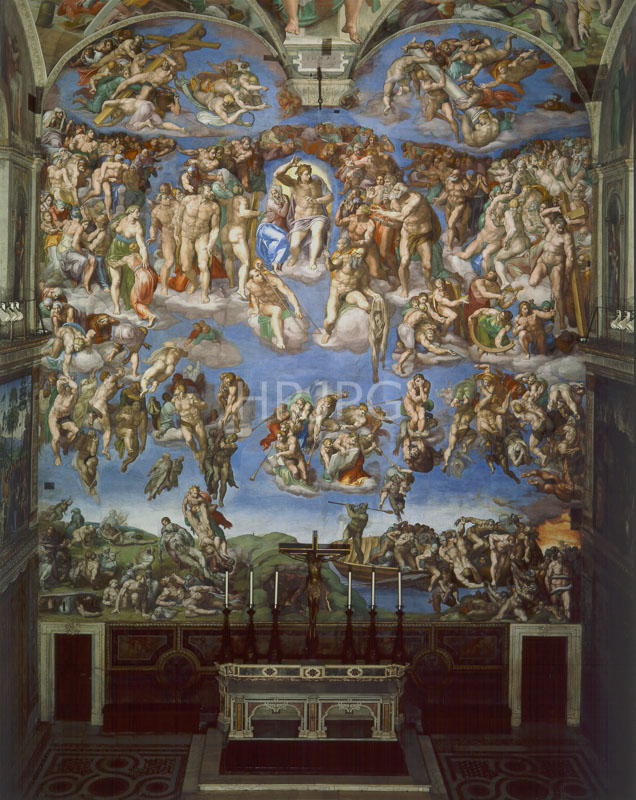
The Last Judgement is a monumental fresco covering the entire altar wall of the Sistine Chapel, commissioned more than twenty years after the completion of the ceiling. Michelangelo depicts the Second Coming of Christ and the final separation of the saved from the damned. The composition is a radical departure from earlier, more structured representations of the judgment; instead, it is a swirling, unified vortex of over three hundred figures caught in a cosmic struggle. At the center stands a youthful, Herculean Christ, whose commanding gesture initiates the rising of the dead and the descent of the wicked. This work reflects the religious turbulence and spiritual anxiety of the Counter-Reformation, moving away from Renaissance harmony toward a more expressive and emotionally raw "terribilità."
The figures in the "Last Judgement" are characterized by a heavy, muscular anatomy that borders on the Mannerist style. Michelangelo focuses on the human body as the primary site of spiritual drama, showing saints, martyrs, and damned souls in various extreme states of exertion and psychological angst. The lower left shows the dead rising from their graves, while the lower right depicts Charon ferrying the damned into the infernal regions, influenced by Dante’s "Divine Comedy." The use of deep, bruised shadows and a somber color palette enhances the sense of divine judgment and eternal consequences. Unlike the idealized figures of the ceiling, these bodies appear more burdened and contorted, reflecting the artist’s own late-life contemplations on mortality and divine grace.
Historically, this fresco was met with both awe and controversy upon its unveiling, particularly due to the extensive nudity, which led to the "Cinquecento" campaign to cover the figures with drapery. Technically, the work is a tour de force of scale and complexity, showcasing Michelangelo’s ability to organize a massive narrative without losing the individual psychological depth of its characters. It marks a pivotal moment in the history of art, signaling the end of the High Renaissance and the birth of a more dramatic, visionary style that would influence generations of Baroque artists. It remains one of the most powerful and challenging religious images ever created, standing as a testament to the enduring genius of an artist who captured the terrifying majesty of the divine will.