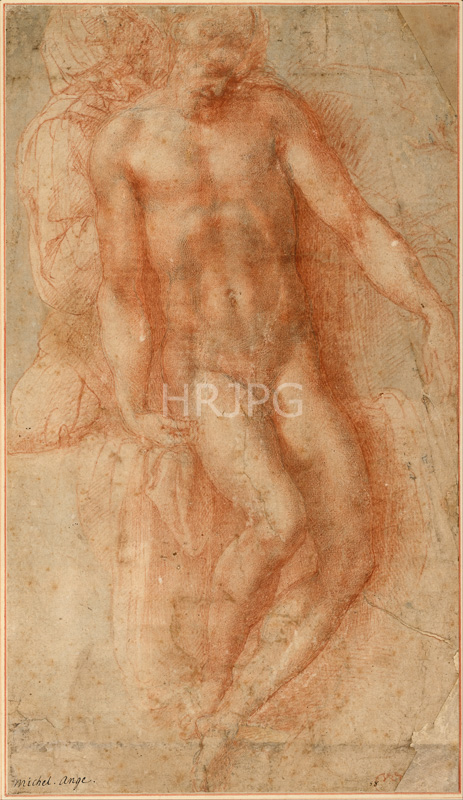
This highly finished red chalk drawing, the "Pieta for Vittoria Colonna," is one of Michelangelo’s most famous and spiritually intimate "presentation drawings." Created as a personal gift for the noblewoman Vittoria Colonna, with whom the artist shared a deep platonic and religious bond, the work represents a refined and vertically oriented interpretation of the traditional mourning theme. The youthful Virgin Mary is shown seated against a cross inscribed with a verse from Dante, supporting the limp body of the dead Christ between her knees. Two mourning angels flank the figures, their gestures reflecting a state of profound grief and reverence. This work is a masterpiece of psychological depth and technical refinement, rendered with a soft luminosity that transcends the material medium.
The figure of Christ is modeled with an extraordinary anatomical precision, his lifeless muscularity serving as a poignant reminder of the physical reality of the sacrifice. Michelangelo utilizes a sophisticated "sfumato" technique to create smooth transitions between light and shadow, giving the skin a translucent, marble-like quality. The Virgin’s pose, with her arms raised in a gesture of prayer and acceptance, emphasizes the spiritual dignity of grief. The verticality of the composition directs the viewer’s eye toward the cross, linking the mortal suffering of Christ to the promise of eternal salvation. Unlike his earlier sculptural Pieta, this drawing focuses on the quiet, internal dialogue between the characters, reflecting the artists late-life interest in the themes of divine grace and the vulnerability of the soul.
Historically, the "Pieta for Vittoria Colonna" reflects the intellectual and religious climate of the "Spirituali" circle in Rome, where the search for personal spiritual renewal was paramount. It became a highly influential image, disseminated through numerous copies and prints across Europe. Technically, the work set a new standard for finished drawings in the Renaissance, proving that paper and chalk could achieve the monumental impact of painting or sculpture. Held in the Isabella Stewart Gardner Museum (or similar world-class collections), it remains an iconic image of the High Renaissance, demonstrating why Michelangelo was considered the supreme master of the human condition. It stands as a hauntingly beautiful testament to the power of art to communicate the deepest mysteries of faith and the enduring strength of the human spirit.