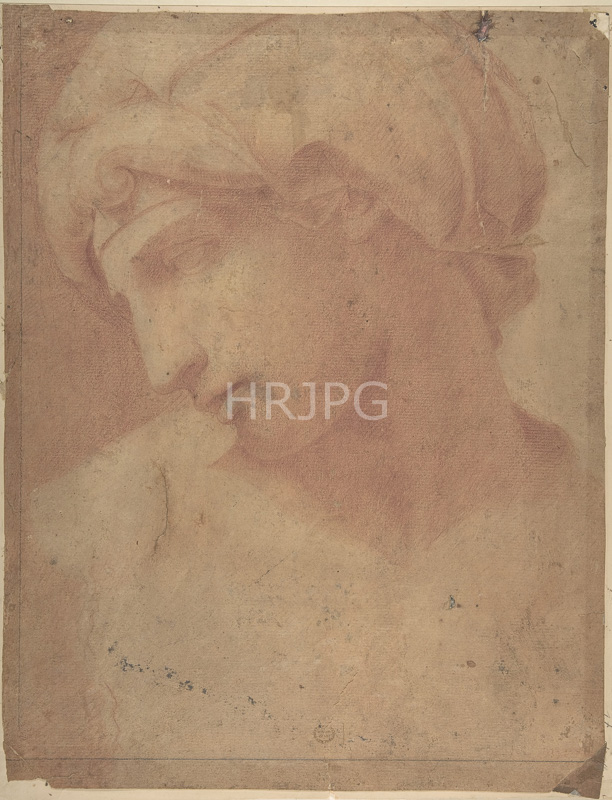
This exquisite 16th-century red chalk drawing is a detailed and reverent study of the head of Michelangelo’s marble sculpture "Dawn" (Aurora), which adorns the tomb of Lorenzo de' Medici in the New Sacristy of San Lorenzo in Florence. Attributed to an anonymous but highly skilled contemporary artist, the work captures the subtle modeling and the profound, melancholic expression of the original masterpiece. Through precise and delicate red chalk hatching, the artist translates the hard, luminous surface of the marble into a soft and living graphic medium. This study reflects the mid-16th-century practice of "disegno," where artists meticulously copied Michelangelo’s works to master the complexities of human anatomy and emotional characterization.
The modeling of the features—the heavy eyelids, the slightly parted lips, and the soft transitions across the cheeks—is executed with a sophisticated sense of light and shadow. The use of red chalk allows for a luminous skin texture that mimics the tactile quality of polished stone under varying light conditions. The artist captures the "terribilità" and the quiet dignity of the Sibylline figure, emphasizing the psychological depth that Michelangelo imbued into his sculptures. The rhythmic flow of the hair and the delicate positioning of the head convey a state of awakening or weary consciousness, a central theme of the Medici Chapel program. This focus on the individual facial features as a vessel for the soul demonstrates the high level of intellectual and physical scrutiny applied to the master’s models by his followers.
Historically, this drawing is significant as a document of the early reception and study of the Medici tombs. It highlights the role of the sculptor’s vision in shaping the visual language of the High Renaissance and the Mannerist style across Europe. Technically, the work serves as a masterclass in red chalk technique, showcasing the artist’s ability to achieve a monumental impact through a restrained and disciplined visual language. Now held in prestigious museum collections such as the Metropolitan Museum of Art, this study remains a vital object for understanding the foundations of academic drawing traditions. It stands as a hauntingly beautiful reminder of Michelangelo’s enduring influence and the ability of a faithful copy to preserve and communicate the deep emotional truth of the original masterpiece for centuries to come.