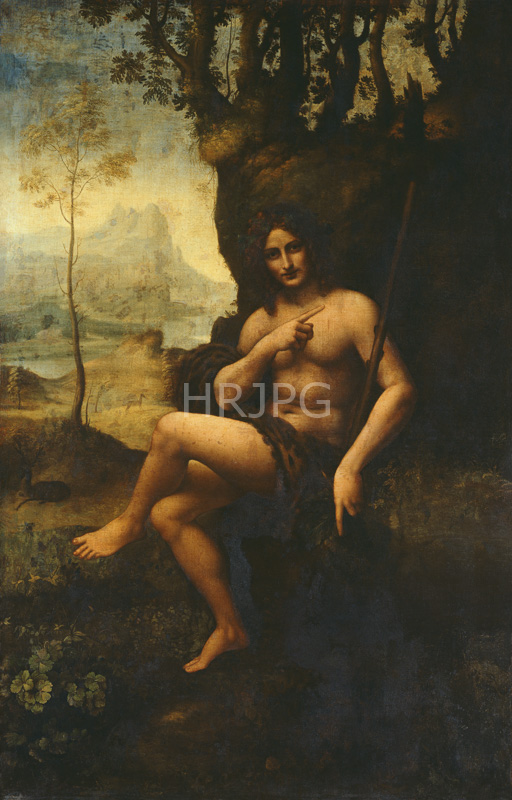
The central figure is seated in a dense and mysterious landscape, pointing one finger toward the viewer while holding a thyrsus—an attribute of Bacchus that was added by a later hand to replace the original cross of the saint. Similarly, a wreath of ivy was added to the figure's hair, further emphasizing the transition from a Christian martyr to a pagan deity. These modifications highlight the fluid nature of Renaissance iconography and the ways in which works could be repurposed to fit new thematic contexts.
The lean and muscular body of the figure, along with his enigmatic smile and long, curling hair, reflects the Leonardesque ideal of beauty that blurred the lines between the masculine and feminine. The use of sfumato is evident in the soft shadows around the eyes and mouth, creating an atmospheric depth and psychological ambiguity that is characteristic of Leonardo’s late style. The figure’s androgynous quality serves to elevate the subject beyond the purely human, touching upon the divine or the supernatural.
In the background, a hazy landscape featuring jagged rocks and blue-tinted mountains recedes into the distance, using aerial perspective to create a sense of vast, primeval space. The lighting is soft and diffused, emerging from an undetermined source to highlight the curves of the torso and the subtle texture of the skin. This interplay of light and shadow unifies the figure with his environment, suggesting a deep, pantheistic connection between the subject and the natural world.
Despite the later modifications, the underlying structure of the painting remains rooted in the devotional traditions of the High Renaissance. The complex pose of the figure, with the torso turned away from the limbs, suggests a restless energy that is tempered by the tranquil, knowing expression on the face. Many art historians argue that the majority of the execution was carried out by Leonardo’s most talented pupils, such as Francesco Melzi or Cesare da Sesto, working under the master’s direct and meticulous supervision.
The panther skin draped over the figure’s lap is another classical attribute associated with the god of revelry, yet it sits in juxtaposition with the refined elegance of the pose. The delicate rendering of the plants in the foreground, such as the grasses and flowers, demonstrates the meticulous study of nature that was a hallmark of the Vinci workshop. This scientific accuracy provides a grounded reality to an otherwise surreal and contemplative composition.
The work continues to challenge viewers with its fluid identity and masterful technical execution, standing as a bridge between the spiritual and the mythological in European art history. The influence of this specific androgynous figure can be seen in later Mannerist and Baroque traditions, where the ambiguity of gender and sacredness became a central focus of artistic exploration. Ultimately, the movement of the hand pointing upward remains a lingering signifier of the painting's original holy purpose, even as the surrounding attributes celebrate the earthly joys of the wine god.