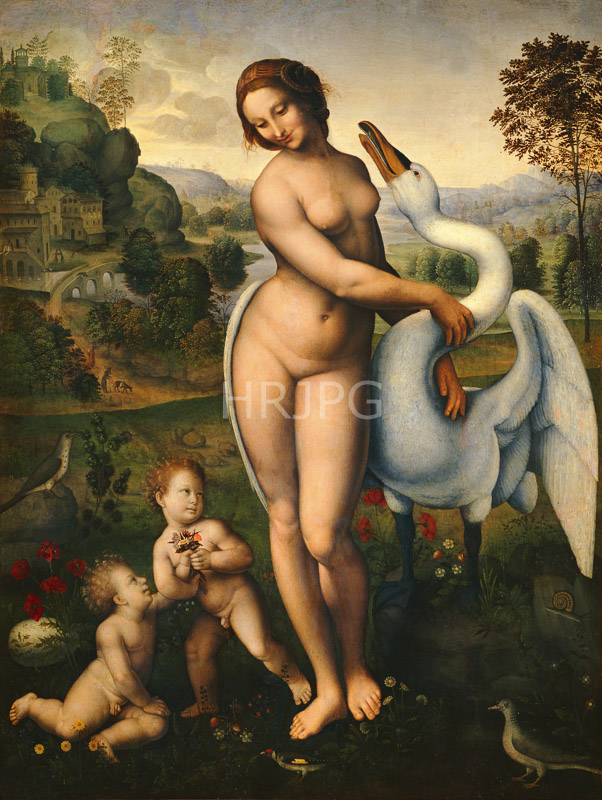
The scene shows the nude queen Leda standing in a graceful contrapposto pose while embracing a large white swan, who represents the god Zeus in disguise. At Leda’s feet, her four children are shown hatching from two large eggs. These infants are identified as Castor, Pollux, Helen of Troy, and Clytemnestra, who would go on to play pivotal roles in Greek mythology. The arrangement of the infants and the intricate details of the swan's feathers demonstrate the high level of skill maintained in Leonardo’s Milanese school and his ability to imbue even mythological subjects with a sense of living realism.
The background is a lush and detailed landscape filled with various botanical species such as flowers, ferns, and trees, all rendered with the scientific precision that Leonardo favored. A distant view of a castle or city and misty blue mountains can be seen on the horizon, creating a sense of deep space and atmospheric perspective. The figures of Leda and the swan are modeled with soft chiaroscuro and sfumato, giving them a lifelike volume and a sense of gentle movement. The erotic and fertile themes of the myth are handled with a refined elegance that avoids the overt vulgarity often found in later interpretations of the subject.
The painting highlights the Renaissance fascination with classical antiquity and the exploration of complex themes such as transformation and divine intervention in human affairs. The use of vibrant yet harmonized colors adds to the overall decorative appeal of the work, which was likely intended for a private collection of a noble patron. Scholars believe that Leonardo's interest in the Leda myth was partly driven by his scientific curiosity about the mechanics of birth and the growth of living organisms, bridging the gap between artistic creation and natural observation.
While the various copies of the Leda composition differ in their background details, the central group remains a consistent testament to the master's creative genius. This specific version is often attributed to artists in the circle of Cesare da Sesto or Francesco Melzi, who were the closest guardians of Leonardo’s artistic legacy after his death. The curve of Leda’s body echoes the "figura serpentinata" or serpentine lines found in other Vinci works, such as the 'Virgin and Child with Saint Anne,' creating a visual harmony that is both complex and pleasing to the eye. Ultimately, the presence of the hatching children emphasizes the cycle of life and the mysterious origins of heroes in the ancient world.