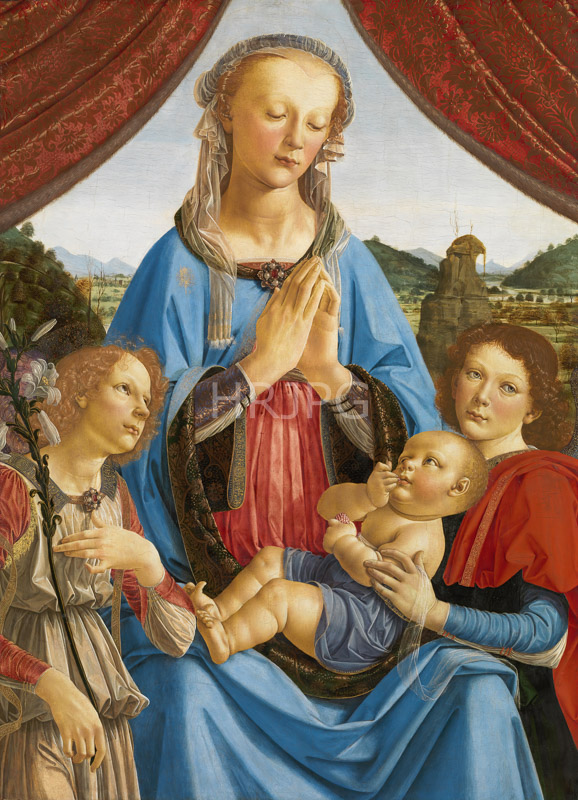
This exquisite panel painting, "The Virgin and Child with Two Angels," is a quintessential example of the Florentine workshop tradition during the late 15th century. Andrea del Verrocchio, a master who famously mentored Leonardo da Vinci, showcases here his dual mastery as both a sculptor and a painter. The influence of his sculptural background is immediately evident in the solid, three-dimensional modeling of the Virgin’s face and the heavy, articulated folds of her blue mantle and red tunic. The Virgin is depicted in a state of solemn prayer, her hands joined with a grace that feels both earthy and divine. The infant Christ, held securely by two young, curly-haired angels, looks toward the viewer with a gaze of precocious wisdom.
The composition is set against an architectural interior that opens up through a window or loggia to a distant, meticulously rendered landscape. This use of "sfumato" in the background—a technique of blending colors to create a hazy, atmospheric effect—hints at the experiments that Verrocchio’s most famous pupil, Leonardo, would soon bring to fruition. The jewels adorning the Virgin’s garments and the intricate details of the gold-threaded embroidery reflect the high technical standards of Verrocchio’s studio, which functioned as a creative hub for the greatest minds of the Renaissance. Art historians often debate the extent to which Verrocchio’s assistants participated in this work, but the overall design remains firmly attributed to the master himself.
The painting serves as a bridge between the linear precision of the early Renaissance and the emotional, atmospheric depth of the High Renaissance. The interaction between the figures—the maternal devotion of Mary and the supportive presence of the angels—creates a sacred narrative that is both intimate and monumental. Every element, from the translucent veils on Mary's head to the soft textures of the children's skin, is handled with a refinement that emphasizes the tactile quality of the oil and tempera medium. This work remains a cornerstone for understanding the evolution of the Virgin and Child motif in Italian art, representing a moment of peak stylistic harmony before the dramatic innovations of the 16th century.