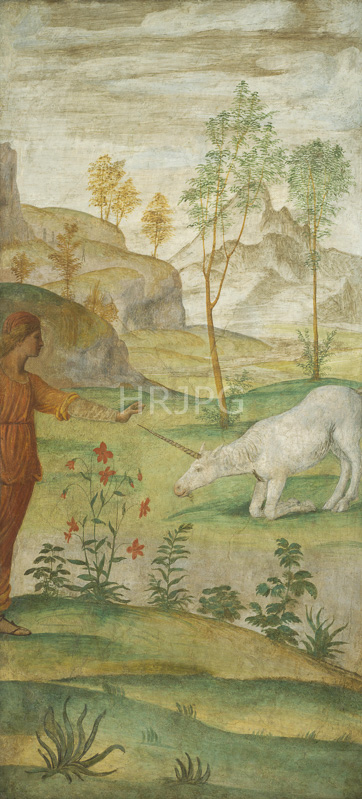
Part of the extensive fresco cycle originally commissioned for the Villa Pelucca near Monza, "Procris and the Unicorn" is one of Bernardino Luini’s most poetic and enigmatic works. Luini, who was heavily influenced by the style of Leonardo da Vinci, managed to synthesize the master's soft "sfumato" with his own penchant for narrative clarity and decorative beauty. In this specific scene, the mythological figure of Procris is shown in a lush, pastoral landscape, encountering a white unicorn. In Renaissance iconography, the unicorn was a complex symbol: it frequently represented chastity and purity, but also the untamed forces of nature that could only be calmed by a virgin.
The placement of Procris—who is central to a tragic story of jealousy and accidental death involving her husband Cephalus—beside the unicorn adds a layer of symbolic irony. Luini uses a gentle color palette, dominated by soft greens, earthy browns, and the luminous white of the unicorn, to create a dreamlike atmosphere. The landscape is not merely a backdrop but an active participant in the story, featuring the "Leonardesque" jagged blue mountains in the far distance and a variety of carefully observed botanical details in the foreground. The way Luini handles light across Procris's red dress and her tranquil expression demonstrates his ability to translate divine serenity into secular mythology.
This fresco was likely intended to celebrate the virtues of the patron’s family, using the myth of Cephalus and Procris (drawn from Ovid's Metamorphoses) as a vehicle for complex moral reflection. Despite being detached from its original architectural context and moved to museum walls, the work retains its decorative power and narrative intimacy. Luini’s figures possess a characteristic sweetness and "leonardesque" grace—evident in the heavy-lidded eyes and subtle smiles—that made his work highly sought after in early 16th-century Lombardy. This painting stands as a testament to Luini's status as the most popular "Leonardeschi" artist, who softened the master's intellectual rigour into something more accessible and lyrical for the Milanese elite.