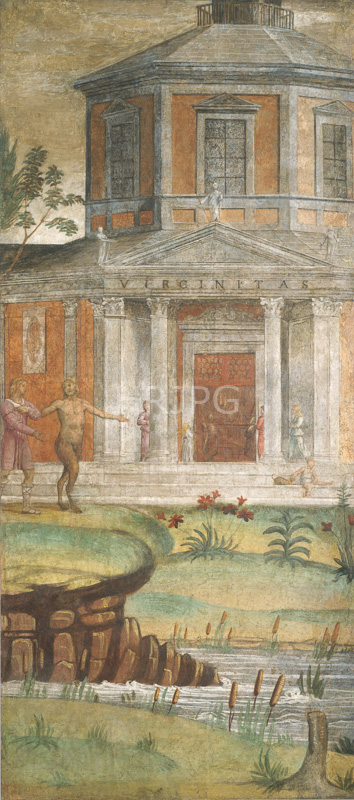
"Cephalus and Pan at the Temple of Diana" is another masterful component of the Villa Pelucca fresco cycle, which stands as Luini's most ambitious narrative achievement. This panel depicts a crucial moment in the tragic myth of Cephalus. The protagonist is seen interacting with the goat-legged god Pan near a classical, circular temple dedicated to Diana, the goddess of the hunt. The inclusion of the temple is a clear nod to Renaissance humanism and the architectural theories of the time, echoing the ideal "tempietto" structures favored by Bramante and Perugino. The temple symbolizes divine order and the sacred laws of nature, providing a rigid, geometric contrast to the organic, flowing forms of the trees and figures.
In this scene, Cephalus appears to be seeking solace or divine intervention, while Pan represents the wild, unbridled impulses of the forest that often lead to mythological tragedy. Luini's landscape is particularly noteworthy; it transitions from the warm, sun-drenched foreground to a misty, atmospheric distance using aerial perspective. The figures are rendered with Luini’s signature elegance—rounded forms, soft transitions between light and shadow, and an overall sense of rhythmic movement. The interaction between the mortal Cephalus and the immortal Pan underscores the Renaissance fascination with the intersection of human destiny and the capricious nature of the gods.
The fresco displays Luini’s technical proficiency in the medium; despite the inherent challenges of painting on wet plaster, he achieved a level of detail in the costume and the temple’s masonry that is usually reserved for panel paintings. The narrative unfolds horizontally, encouraging the viewer to read the scene from left to right as part of the larger story of Cephalus and Procris. The emotional tone is one of quiet contemplation rather than high drama, characteristic of Luini’s late style where even moments of tension are handled with a sense of decorative poise. By placing these mythological figures within a recognizable Lombard landscape, Luini made the ancient myths feel present and relevant to his 16th-century audience, cementing his role as a bridge between the classical past and the Renaissance present.