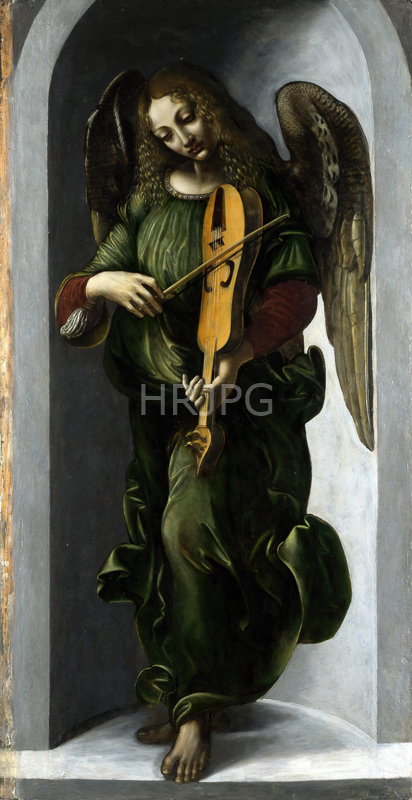
This striking panel, "An Angel in Green with a Vielle," was originally part of a grander structure—the monumental altarpiece for the Church of San Francesco Grande in Milan, which also featured Leonardo da Vinci’s famous "Virgin of the Rocks" (London version). While Leonardo painted the central sacred scene, his associate Giovanni Ambrogio de Predis was commissioned to paint the flanking panels of musician angels. This specific angel, dressed in a rich, emerald-green robe with intricate gold detailing, plays a vielle, a medieval stringed instrument that was a precursor to the modern violin. The angel stands within a stone niche, a device that adds a sense of architectural depth and anchors the figure within the larger context of the altarpiece.
Giovanni Ambrogio de Predis was the primary court painter for the Sforza family in Milan, and his style is characterized by a high degree of technical precision and a focus on luxurious materials. While he lacks the profound psychological depth and fluid "sfumato" of Leonardo, his work provides a fascinating counterpoint to the master’s style. In this angel, de Predis captures the tactile qualities of the heavy silk fabric and the polished wood of the instrument with remarkable clarity. The angel’s expression is one of serene focus, embodying the celestial harmony that music was thought to represent in a religious setting.
The contrast between this panel and Leonardo’s central work is a frequent subject of art historical study, illustrating how two artists of different temperaments could collaborate on a single religious commission. The "Angel in Green" serves a liturgical purpose, symbolizing the "Musica Sacra" (Sacred Music) that accompanies the Virgin and Child. The figure is modeled with strong chiaroscuro, giving it a powerful physical presence that complements the ethereal qualities of Leonardo’s figures. Over the centuries, these panels have come to be recognized as masterpieces of the Milanese Renaissance in their own right, reflecting the high cultural sophistication of the Milanese court under Ludovico il Moro. They demonstrate how de Predis adopted certain "Leonardesque" elements, such as the idealized facial features and the soft treatment of the hair, while maintaining the rigorous detail of his own training.