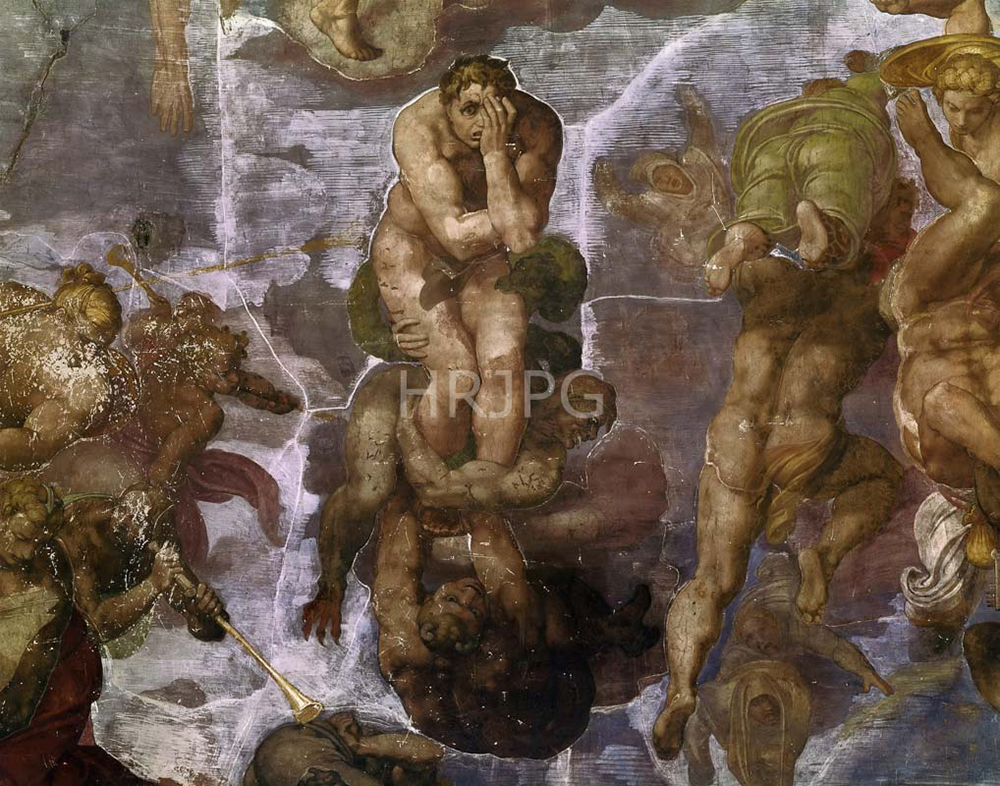
This harrowing detail from Michelangelo’s "The Last Judgment," located on the altar wall of the Sistine Chapel in the Vatican, is one of the most powerful representations of psychological torment in the history of art. It depicts a "Damned Soul" (often referred to as the "Huddled Figure") at the moment he realizes his eternal fate. Unlike the classical, heroic nudes of Michelangelo's earlier "Sistine Ceiling," this figure is contorted by an internal agony that transcends physical pain. He sits with one hand covering his eye, as if he cannot bear to see the descent into hell, while his other hand clutches his leg in a gesture of absolute despair. Beneath him, demons with grotesque features are dragging him downward, their muscular arms pulling his weight toward the abyss.
Michelangelo’s use of the human body here is "mannerist" in its intensity; the proportions are heavy and exaggerated, emphasizing the crushing burden of sin. The figure’s face, partially obscured, is a mask of horror—wide-eyed and gaping in silent realization. This specific detail captures the terrifying shift in the late Renaissance from the optimistic humanism of the early 1500s to the religious anxiety and turbulence of the Counter-Reformation. Michelangelo painted this masterpiece over twenty years after the ceiling, and his style had evolved into something much darker, more muscular, and more emotionally raw.
The "Damned Soul" has become an icon of existential dread. Scholars have suggested that this figure represents the individual’s internal struggle with conscience and the weight of a life misspent. The surrounding chaos of the "Last Judgment"—where hundreds of figures rise to heaven or fall to hell—is condensed into this single, solitary moment of realization. The color palette is somber, with flesh tones that appear bruised and shadowed, set against a chaotic, swirling background of blue and gray. Michelangelo’s genius lay in his ability to use the anatomy of the back and the tension in the limbs to communicate a state of mind that words could not reach. This figure remains a profound reminder of the power of art to confront the darkest aspects of the human condition, standing as a pivotal moment where the Renaissance ended and the expressive power of the Baroque began to take shape.