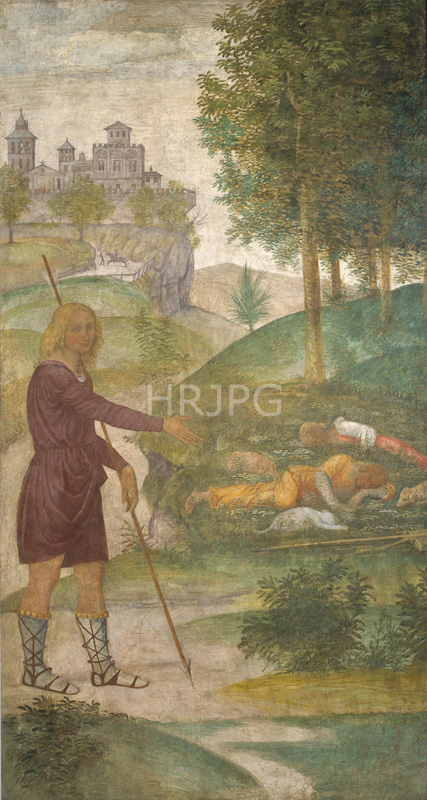
This fresco, titled "Cephalus and the Nymphs," is a vital segment of the decorative cycle Luini executed for the Villa Pelucca. The scene captures the protagonist Cephalus, a mortal hunter from Greek mythology, in a moment of transition or wandering within a verdant, enchanted forest. Luini’s interpretation of this myth, drawn largely from Ovid's Metamorphoses, emphasizes the quietude and mysterious allure of nature rather than the overt violence often associated with these tales. In the composition, the nymphs are depicted with the soft, idealized features characteristic of the "Leonardeschi" style—heavy-lidded eyes, subtle, enigmatic smiles, and a palpable sense of grace. These figures emerge from the landscape almost as extensions of the forest itself, their forms modeled with a delicate chiaroscuro that avoids harsh outlines.
The landscape plays a crucial role in establishing the mood. Luini employs a palette of earthy greens, ochres, and the signature "Leonardesque" blue for the distant, jagged mountains, creating an atmospheric depth through aerial perspective. The rocky grottoes and scattered botanical details—rendered with scientific curiosity—reflect the influence of Leonardo da Vinci’s studies of nature. However, Luini simplifies these complexities into a more decorative and accessible visual language, suitable for the domestic interior of a grand villa. The interaction between the human figure and the supernatural beings suggests a world where the boundaries between the mortal and the divine are fluid.
Technically, Luini’s mastery of the fresco medium is evident in the luminosity of the skin tones and the rhythmic flow of the drapery. Despite the challenges of painting on wet plaster, he achieves a level of psychological intimacy that was rare in large-scale mural painting of the early 16th century. This specific panel serves to heighten the narrative tension of the Cephalus and Procris cycle, illustrating the temptations and external forces that will eventually lead to the couple’s tragic end. The work stands as a testament to Luini’s ability to modernize classical antiquity for his contemporary Milanese patrons, blending the intellectual rigor of the High Renaissance with a lyrical, almost poetic sensibility that became his artistic hallmark. It remains one of the most significant examples of mythological fresco cycles in Northern Italy, representing the peak of Luini's creative output during his residency at the Villa Pelucca.