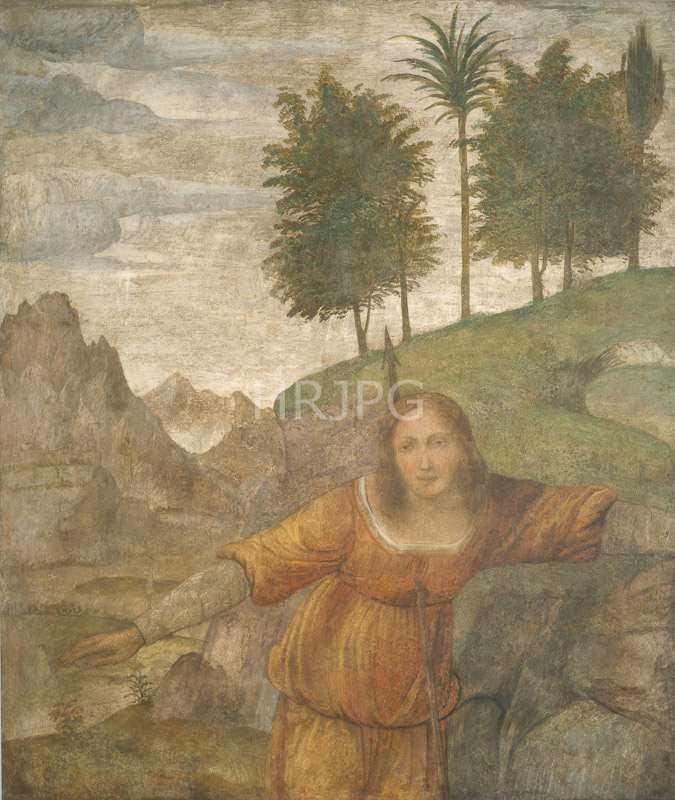
"Procris Pierced by Cephalus' Javelin" represents the tragic climax of the myth of Cephalus and Procris, depicted with a profound sense of melancholy and Leonardesque refinement. The narrative tells of a misunderstanding born of jealousy: Procris, suspecting her husband Cephalus of infidelity, hides in the bushes to observe him. Cephalus, hearing a rustle and believing it to be a wild animal, throws his magical, never-missing javelin, only to find that he has mortally wounded his beloved wife. Luini captures the immediate aftermath of this realization. Procris is shown in an elegant but limp pose, her body collapsing against the rugged landscape, while Cephalus gazes upon her in a state of frozen horror and grief.
Luini’s stylistic choices mitigate the gore of the event, focusing instead on the emotional and spiritual weight of the tragedy. The figure of Procris is rendered with an exquisite delicacy; her red gown provides a stark, symbolic contrast to the muted greens and browns of the forest, representing both her life force and the wound that ends it. Her facial expression is not one of agony, but of a quiet, resigned sorrow, echoing the "sweet" style for which Luini was celebrated. The landscape, characterized by dense foliage and distant, misty peaks, acts as a silent witness to the unfolding human drama. The soft "sfumato" transitions between the figures and their environment emphasize the accidental and inevitable nature of the event—as if the forest itself had conspired in the tragedy.
This work is significant for its demonstration of Luini’s ability to translate complex emotional narratives into a decorative fresco format. He moves away from the intense muscularity and dynamism favored by Roman Mannerists, opting instead for a rhythmic and harmonious composition that preserves the dignity of the figures even in death. The influence of Leonardo is visible in the anatomical precision and the psychological depth of Cephalus' expression, which conveys a mixture of guilt and disbelief. As part of the Villa Pelucca cycle, this panel served as a moral warning about the dangers of suspicion and the fragility of human happiness. Today, it is regarded as a masterpiece of Renaissance narrative painting, showcasing how Luini successfully balanced the demands of monumental wall decoration with the intimacy and subtlety of High Renaissance portraiture and religious art.