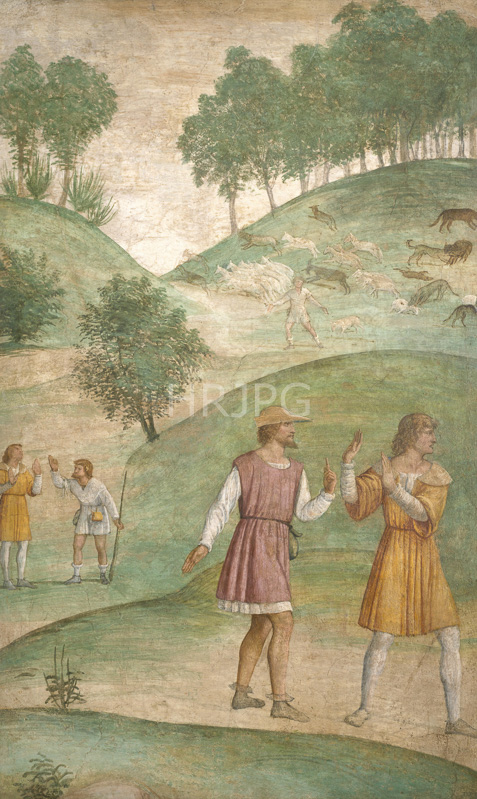
This panel, titled "The Misfortunes of Cephalus," acts as a narrative bridge within the Villa Pelucca fresco cycle, focusing on the social and psychological dimensions of the myth. It depicts Cephalus and another figure, likely a messenger or a confidant, engaged in a grave and urgent conversation within an expansive, sun-drenched landscape. The "misfortunes" referred to in the title encompass the early stages of the tragedy—the onset of suspicion, the intervention of the goddess Aurora, and the beginning of the estrangement between Cephalus and his wife Procris. Luini uses the interaction between the two men to convey a sense of mounting anxiety, achieved through expressive hand gestures and the intense, focused gazes of the figures.
Stylistically, the work is a prime example of Luini's mature Lombard style. The figures are placed prominently in the foreground, their presence made monumental by their proximity to the viewer and their clear, articulated silhouettes against the open landscape. Luini’s use of color is particularly sophisticated here; the warm tones of the figures' clothing are set against the cool, receding blues of the mountains and the pale, luminous sky. This use of color temperature creates a naturalistic sense of time and place, suggesting the clarity and stillness of a Mediterranean morning. The influence of Leonardo da Vinci remains apparent in the soft modeling of the faces and the subtle "sfumato" that blurs the transition between the hair and the background.
The landscape is a crucial narrative element, representing the world outside the palace walls where the myths of antiquity were thought to take place. By setting these classical figures in a landscape that would have been familiar to his Milanese audience, Luini makes the ancient story feel contemporary and relatable. The architectural elements in the far distance—small villas or castles—further bridge the gap between the mythic past and the Renaissance present.
In the context of the Villa Pelucca, this fresco would have served to advance the plot while providing a visually restful, panoramic scene for the viewer. It demonstrates Luini’s skill as a storyteller who understands that silence and anticipation are often as powerful as action. The work reflects the high cultural aspirations of the Rabia family, the original patrons, who sought to surround themselves with art that was both intellectually stimulating and aesthetically pleasing. "The Misfortunes of Cephalus" stands as a testament to Luini’s role as the preeminent muralist of his generation, capable of imbuing even transitional narrative moments with a sense of eternal grace and profound human relevance.