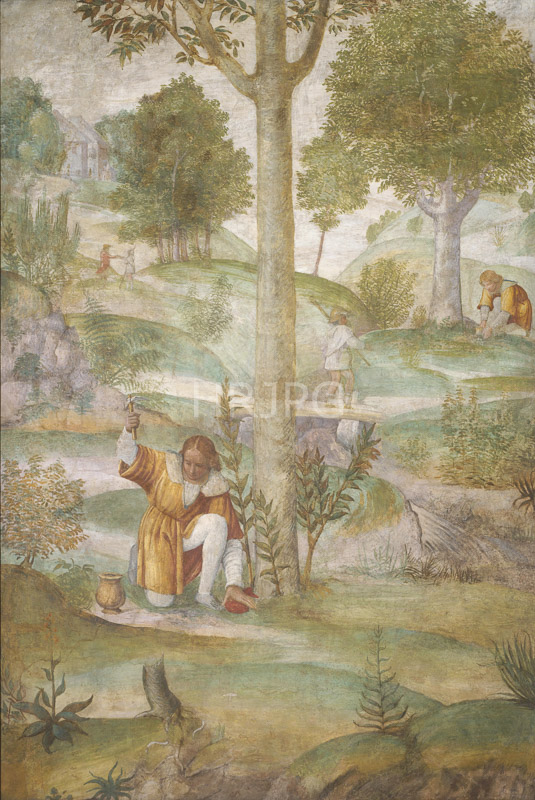
"Cephalus Hiding the Jewels" illustrates the catalyst for the tragic events that follow in the myth of Cephalus and Procris. According to the legend, Cephalus, urged by the goddess Aurora, decides to test his wife’s fidelity by returning to her in disguise and attempting to seduce her with precious jewels. Luini captures the moment of preparation or the actual act of concealment, emphasizing the themes of deception, material temptation, and the fragility of trust. The protagonist is shown in a moment of moral ambiguity, his actions shadowed by the lush but isolating environment of the forest.
Luini excels in this panel at rendering the tactile qualities of the luxury objects and the intricate fabrics of the Renaissance costumes. The "jewels" mentioned in the title become a focal point, catching the light and symbolizing the worldly distractions that can lead to spiritual or domestic ruin. The figures are modeled with the gentle, rounded forms characteristic of Luini's middle period, showing a clear lineage from Leonardo’s "Virgin and Child with Saint Anne." The facial expressions are masterfully subtle; Cephalus' expression is a complex blend of determination and lingering doubt, providing a psychological depth that elevates the work beyond mere decoration.
The composition follows a horizontal narrative flow, encouraging the viewer to read the scene as the beginning of a sequence. The background landscape features the typical Lombard elements: winding paths, meticulously detailed foliage, and the distant, atmospheric peaks that suggest a vast and mysterious world. The lighting is soft and diffused, creating a mood of quiet introspection that contrasts with the deceptive nature of the act being depicted. Luini uses a harmonious color palette dominated by greens, golds, and deep reds, which would have complemented the architectural surroundings of the Villa Pelucca.
This fresco is particularly important for understanding the moral program of the Villa Pelucca cycle. It introduces the human failings—vanity and suspicion—that drive the mythic tragedy, serving as a cautionary tale for the villa's residents and guests. Luini’s ability to render these complex human emotions with such grace and beauty is what distinguished him from other Leonardo followers. He did not merely mimic the master's technique but applied it to a wide range of secular and mythological subjects, creating a body of work that was uniquely his own. "Cephalus Hiding the Jewels" remains a vital piece of the Milanese Renaissance puzzle, showcasing the era's fascination with the interplay between the classical heritage and contemporary moral philosophy, all expressed through a visual language of peak elegance and technical refinement.