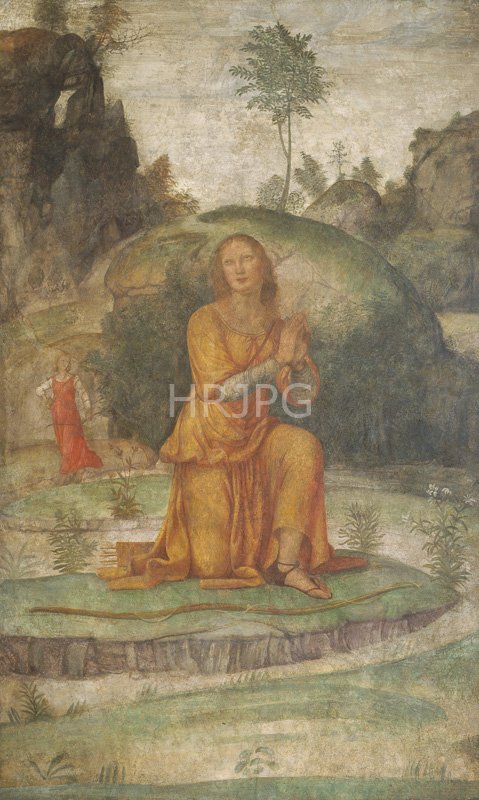
This fresco, titled "Procris' Prayer to Diana," is a poignant and essential component of the Villa Pelucca cycle, illustrating the desperation and religious devotion inherent in the myth of Cephalus and Procris. In this scene, Procris is depicted kneeling in a rugged, almost desolate landscape, lifting her hands in a fervent plea to Diana, the goddess of chastity and the hunt. The narrative context involves Procris seeking divine intervention to restore her husband’s love or perhaps to seek protection from the jealousy that is beginning to consume her. Luini’s treatment of this moment is characterized by a profound sense of interiority; the focus is not on external action, but on the psychological and spiritual state of the protagonist.
Stylistically, the work demonstrates Luini’s exceptional ability to adapt Leonardo da Vinci’s "sfumato" for the medium of fresco. The transitions of light and shadow across Procris’s face and her flowing garments are handled with a characteristic softness that creates a luminous, ethereal effect. Her expression is one of "dolcezza"—a sweet, resigned sorrow that became Luini's signature. The landscape is notably different from the lush forests seen in other panels; here, the jagged rocks and sparse vegetation echo the isolation of the character. The distant mountains are rendered in a pale, atmospheric blue, creating a sense of vast, unbridgeable space between the mortal woman and the divine realm she invokes.
Technically, Luini utilizes a sophisticated color palette, where the vibrant red of Procris's dress serves as a visual anchor amidst the muted greys and greens of the earth. This use of color not only draws the viewer’s eye but also symbolizes the earthly passion that has led to her current distress. The composition is balanced and rhythmic, with the diagonal line of the rocky slope leading directly to the figure of Procris, emphasizing her vulnerability. As part of a grander decorative program, this panel serves to deepen the moral narrative of the cycle, reminding the viewer of the necessity of faith and the perils of human emotion left unchecked.
Today, this fresco stands as a masterpiece of the Lombard Renaissance, showcasing how Luini managed to maintain the intellectual and technical standards of the High Renaissance while infusing his work with a decorative elegance that appealed to the Milanese aristocracy. It represents a peak moment in Luini’s career, where his mastery of narrative, landscape, and human psychology achieved a perfect, harmonious synthesis.