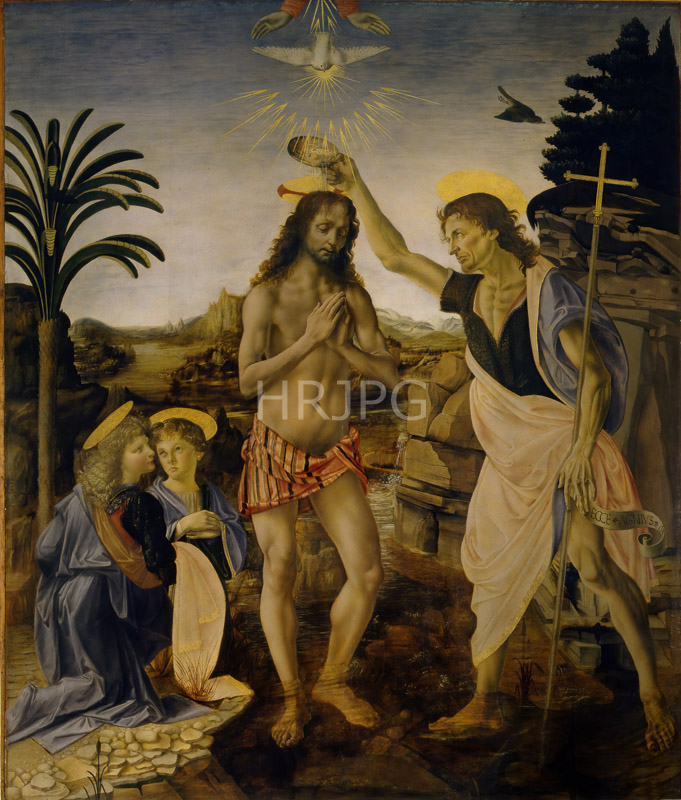
"The Baptism of Christ" is one of the most famous collaborative works in art history, representing the symbolic "passing of the torch" from the master Andrea del Verrocchio to his extraordinary pupil, Leonardo da Vinci. Commissioned for the San Salvi Monastery in Florence, the central figures of Christ and Saint John the Baptist were largely executed by Verrocchio in his signature linear and muscular style. However, the angel on the far left, kneeling with a divine grace that transcends the rest of the composition, is universally attributed to the young Leonardo. It is famously said that when Verrocchio saw the superior quality of Leonardo’s contribution, he vowed never to paint again, recognizing that his student had surpassed him.
Leonardo’s intervention is visible not only in the angel but also in the subtle reworking of the landscape and the atmospheric "sfumato" that blurs the distant horizon. While Verrocchio’s Christ is modeled with sharp outlines and anatomical rigor, Leonardo’s angel is characterized by soft transitions of light and shadow, giving the skin a translucent, lifelike quality and the hair a fine, gossamer texture. The interaction between the two styles creates a fascinating tension; Verrocchio represents the culmination of the 15th-century Florentine tradition, while Leonardo points toward the revolutionary innovations of the 16th-century High Renaissance.
The symbolism of the work is deeply rooted in Christian liturgy. The Holy Spirit, depicted as a dove from which rays of light descend, hovers above Christ, while the hands of God the Father are visible at the very top. The landscape, featuring the Jordan River, is rendered with a new level of naturalism, particularly in the way water flows around Christ's legs and the reflections on the surface. Leonardo’s interest in geology and the movement of water is already evident here, suggesting a scientific approach to nature that would define his entire career. The botanical details, such as the palm tree representing victory over death, are rendered with meticulous care, contributing to the work's overall sense of divine order.
This painting remains a cornerstone for the study of the Italian Renaissance. It illustrates the importance of the workshop system as a breeding ground for genius and highlights the early development of Leonardo’s unique visual language. The angel’s ethereal beauty and the psychological depth of the scene transformed a traditional religious subject into a profound meditation on the intersection of the human and the divine. As a centerpiece of the Uffizi Gallery, it continues to captivate viewers with its historical significance and its breathtaking technical execution.