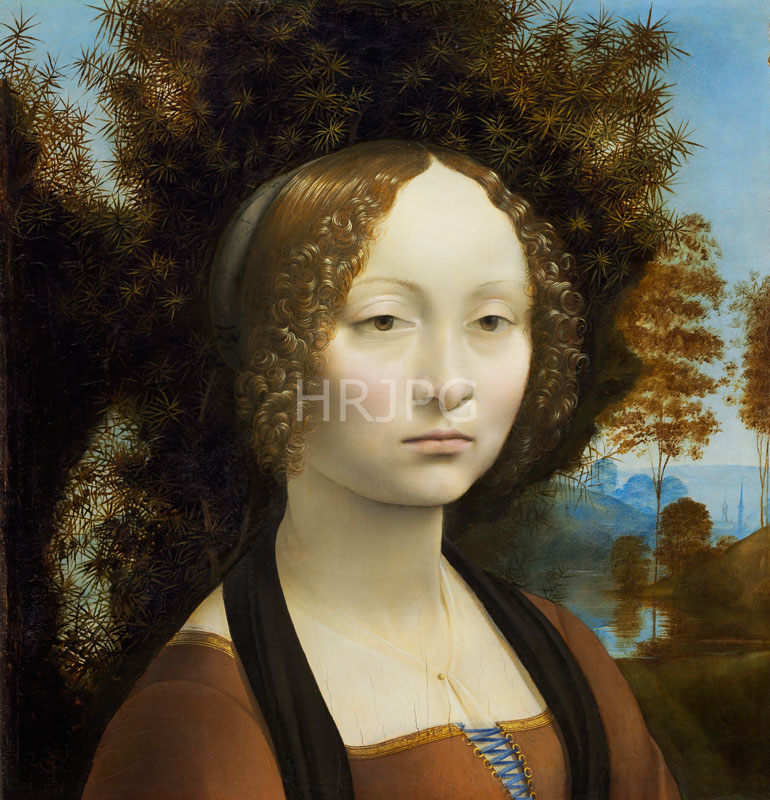
Leonardo da Vinci’s "Ginevra de' Benci" is a landmark in the history of portraiture, representing the first time an artist successfully captured the internal, psychological state of a sitter rather than just their external appearance. Painted during Leonardo’s early period in Florence, it depicts the young noblewoman Ginevra de' Benci, daughter of a wealthy merchant. The portrait is revolutionary for its three-quarter view—a departure from the traditional profile portraits of the time—and for its innovative use of light and shadow to model the porcelain-like skin and intricate golden curls of the subject. Ginevra’s expression is one of detached, somber intelligence, reflecting the intellectual sophistication of the circle in which she moved.
The background of the painting is rich with symbolic meaning. Ginevra is set against a dark, dense juniper bush (known as "ginepro" in Italian), which serves as a clever pun on her name. Beyond the bush, Leonardo provides an atmospheric landscape of trees and water receding into a hazy, blue-tinted distance. This early use of aerial perspective and "sfumato" creates a sense of profound space and air surrounding the figure. Originally, the painting was larger and included the sitter's hands, which were likely folded at her waist, but the bottom portion was cut off due to damage in the past. Even in its truncated state, the work radiates a quiet, monumental power.
The reverse side of the panel is equally significant, featuring a sprig of juniper encircled by a wreath of laurel and palm, accompanied by the Latin motto "Virtutem Forma Decorat" (Beauty Adorns Virtue). This heraldic device suggests that the portrait was commissioned to celebrate both Ginevra’s physical beauty and her intellectual or moral character. Scholars believe the commission may have been linked to her marriage or to her platonic relationship with the Venetian diplomat Bernardo Bembo. The meticulous execution of the reverse side mirrors the high technical standards of the front, showing Leonardo's early obsession with botanical accuracy and symbolic depth.
Technically, "Ginevra de' Benci" showcases Leonardo’s mastery of the oil medium, which he used to achieve a level of detail and luminosity that was far superior to traditional tempera. The way he handles the light reflecting off the water in the background and the individual strands of Ginevra’s hair demonstrates his role as a pioneer of visual realism. As the only painting by Leonardo in a public collection in the United States (the National Gallery of Art in Washington, D.C.), it remains one of the most studied and admired portraits of the Renaissance, standing as a testament to the master’s early genius and his enduring influence on the Western artistic tradition.