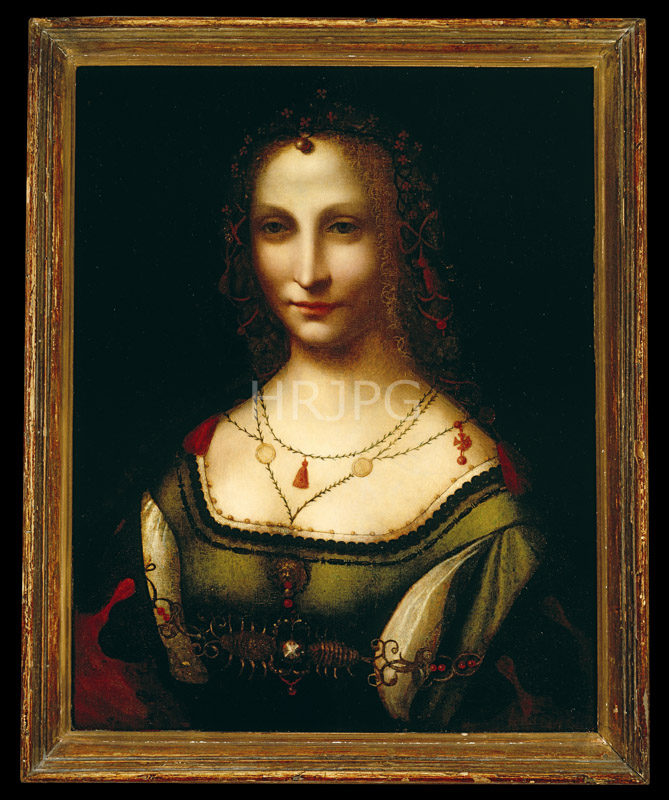
Giovanni Antonio Boltraffio was perhaps the most talented and aristocratic of Leonardo da Vinci’s Milanese pupils, and this "Portrait of a Young Woman with a Scorpion Chain" is one of his most enigmatic and technically refined works. Boltraffio’s style is characterized by a pursuit of "noble beauty" and a high level of technical finish that often rivals his master’s work. In this portrait, a noblewoman is shown in a three-quarter turn against a stark black background, a device that emphasizes her porcelain complexion and the luxurious textures of her attire. The direct, steady gaze of the sitter conveys a sense of poise and aristocratic reserve, hallmarks of the Milanese court style under the Sforza family.
The most striking element of the painting is the delicate gold chain around the woman's neck, which features a prominent scorpion pendant. In Renaissance iconography, the scorpion was a multifaceted symbol; it could represent the zodiac sign of Scorpio, act as an emblem of a specific family, or serve as a paradoxical symbol of both danger and healing. Given the woman's calm and elegant demeanor, the scorpion likely holds a specific personal or heraldic meaning that has been lost over time. Boltraffio captures the metallic sheen of the chain and the intricate patterns of the woman's dark, gold-embroidered gown with a meticulousness that reflects his training in Leonardo’s workshop.
Boltraffio’s use of light is clearly inspired by Leonardo’s "sfumato," but he applies it with a greater sense of clarity and linear precision. The way the light falls across the woman’s forehead and cheek creates a soft, rounded volume, giving her a tangible physical presence. Her hair is styled in the typical Milanese fashion of the era, bound by a thin headband and falling in soft, controlled waves. The overall effect is one of cold, crystalline beauty, where every detail—from the glint of the jewels to the texture of the fabric—is rendered with a scientific curiosity and a decorative flair.
This portrait serves as an important record of the high cultural sophistication of the Milanese Renaissance. Boltraffio was not merely a follower but an artist who developed his own distinct aesthetic, blending Leonardesque lighting with a northern Italian focus on material luxury and social status. The work continues to intrigue scholars and art lovers for its combination of psychological stillness and hidden symbolism. It remains a prime example of how Leonardo’s influence was transformed by his pupils into a distinct "Milanese School" of painting, where the ideal and the real were merged into a single, breathtaking visual image.