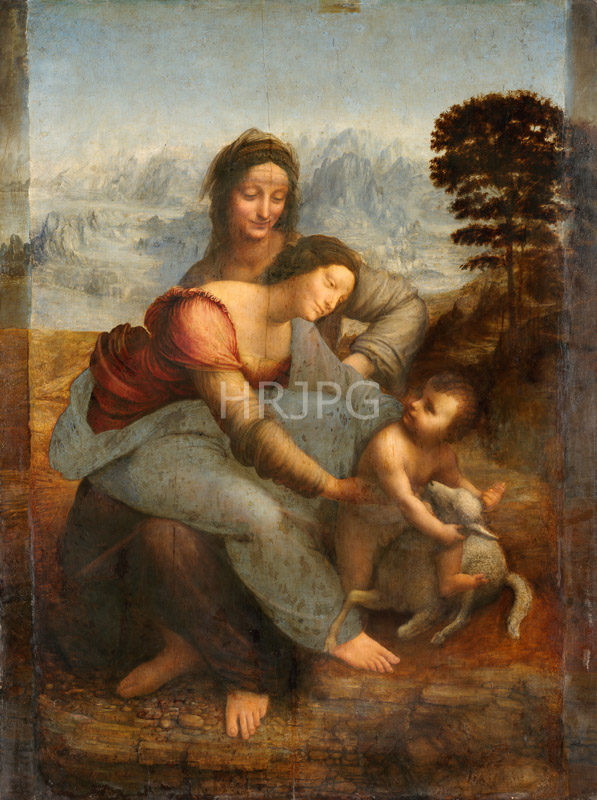
Leonardo da Vinci’s "The Virgin and Child with Saint Anne" is a masterpiece of the High Renaissance, representing the culmination of the master's lifelong exploration of complex composition, maternal psychology, and geological science. This late work, which Leonardo carried with him until his death in France, depicts three generations of the holy family: Saint Anne, her daughter the Virgin Mary, and the infant Christ. The composition is famously organized in a stable yet dynamic pyramidal structure. Mary sits on her mother’s lap, leaning forward to gently restrain the infant Jesus, who is playfully interacting with a sacrificial lamb—a poignant symbol of his future Passion and sacrifice.
The psychological depth of the work is achieved through the interconnected gazes and gestures of the figures. Saint Anne looks upon her daughter and grandson with a serene, almost detached wisdom, as if she foresees the divine destiny that must unfold. Mary’s movement is one of maternal instinct, attempting to hold back the child from his inevitable fate, while the Christ Child looks back at his mother with a precocious understanding. This intergenerational dialogue is rendered with Leonardos signature "sfumato," where the figures seem to emerge from and dissolve into the surrounding atmosphere, creating a sense of ethereal mystery and profound emotional truth.
The landscape in the background is a marvel of Renaissance science and aerial perspective. Leonardo depicts a vast, jagged range of glacial mountains that fade into a misty, pale blue on the horizon. This landscape is not merely a backdrop but a reflection of Leonardo's geological theories regarding the slow erosion of the earth and the movement of water. The rocky terrain and the primeval atmosphere suggest a world in a state of eternal becoming, providing a grand, cosmic context for the sacred narrative in the foreground. The scientific accuracy of the rock formations and the botanical details of the trees demonstrate Leonardo's belief that art and science were inseparable pursuits.
Technically, the painting is a tour de force of oil painting technique. Despite being unfinished in certain areas—a common characteristic of Leonardo's late work—the modeling of the flesh and the translucent layers of the drapery show a level of refinement that few could match. The soft lighting, which appears to have no single source, unifies the composition and imbues it with a divine radiance. As a centerpiece of the Louvre Museum, "The Virgin and Child with Saint Anne" remains one of the most influential works in Western art, inspiring generations of artists from Raphael to the modern era. it stands as a testament to Leonardo's genius for combining mathematical precision with the deepest mysteries of the human soul and the natural world.