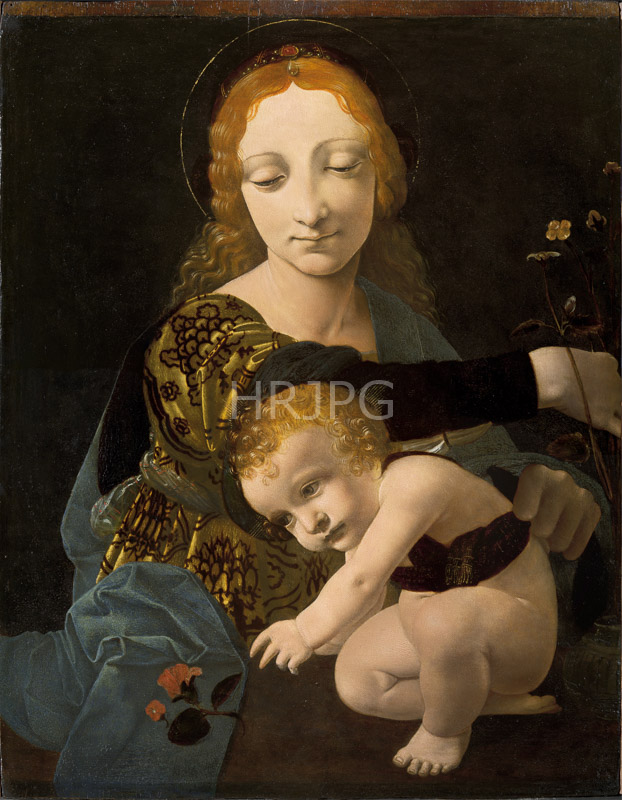
This "Virgin and Child," currently housed in the Poldi Pezzoli Museum in Milan, is widely regarded as one of Giovanni Antonio Boltraffio's finest early works and a quintessential example of the "Leonardesque" style refined for the Milanese aristocracy. Boltraffio, who was perhaps Leonardo da Vinci’s most talented and socially prominent pupil, managed to synthesize his master’s revolutionary techniques with a personal sense of crystalline clarity and cool, aristocratic reserve. In this composition, the Virgin Mary is depicted in a three-quarter turn, cradling a remarkably robust and active infant Christ. The child reaches forward with intense curiosity, his gaze fixed on a small object—likely a carnation or a piece of fruit—that serves as a symbolic precursor to his future sacrifice. The interplay between mother and son is characterized by a quiet, monumental gravity that elevates the domestic scene into a profound theological statement.
Boltraffio’s mastery of "sfumato" is evident in the soft, rhythmic transitions of light across the Virgin’s face, which give her skin a luminous, porcelain-like quality. However, unlike Leonardo’s often hazy and mysterious forms, Boltraffio maintains a high degree of linear precision, particularly in the rendering of the luxurious fabrics. The Virgin’s deep blue mantle, lined with gold embroidery, and her rich brocade gown reflect the material wealth and high fashion of the Sforza court in Milan. The background is a stark, dark void, a dramatic choice that forces the viewer to focus entirely on the sculptural volume of the figures and the intimate psychological connection between them. This use of "chiaroscuro" creates a powerful three-dimensional effect, making the figures appear to emerge from the shadows into the viewer’s space.
Technically, the painting showcases Boltraffio’s meticulous attention to detail, from the individual strands of the Christ child’s golden curls to the subtle reflections of light on the Virgin’s translucent veil. The anatomical modeling of the child—with his chubby, realistic folds of flesh—demonstrates the influence of Leonardo’s scientific studies of human growth. This specific version of the Madonna motif became highly influential in Northern Italy, serving as a model for other "Leonardeschi" artists who sought to replicate the master's unique blend of physical realism and divine grace. The work remains a testament to Boltraffio's status as a master in his own right, one who could take Leonardo’s intellectual innovations and transform them into a visual language of peak elegance and technical perfection.