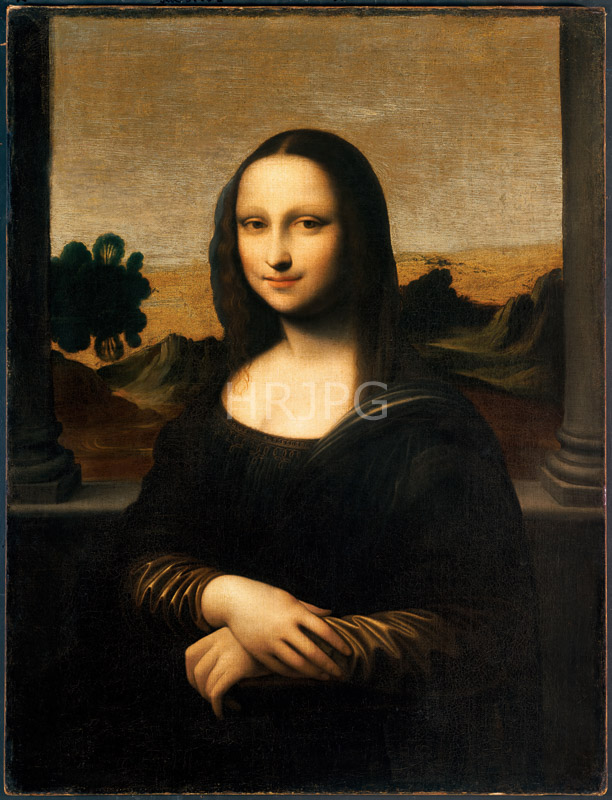
The "Isleworth Mona Lisa" is one of the most intriguing and debated paintings in the history of Renaissance art. Often described as a "younger" version of the world-famous masterpiece in the Louvre, this painting depicts a woman with the same enigmatic smile and posture as Lisa Gherardini, but appearing to be in her early twenties. The work gained its name after being discovered in an English manor in Isleworth in the early 20th century. Unlike the Louvre version, which is painted on a wood panel, the Isleworth version is executed on canvas. It features two prominent classical columns flanking the sitter, a detail that also appears in Raphael’s early sketches of the Mona Lisa, leading some scholars to suggest that this work may represent an earlier, unfinished stage of Leonardo's original concept or a contemporary version created within his immediate circle.
Stylistically, the Isleworth Mona Lisa displays several "Leonardesque" traits, most notably the "sfumato" technique used to model the soft transitions around the eyes and mouth. The lady’s hands, though less detailed than those in the Louvre version, follow the same elegant, folded arrangement. The background is a simplified landscape of hills and water, lacking the complex geological detail and atmospheric depth of Leonardo’s later work. This relative simplicity has led to fierce debate among art historians: some argue it is a genuine Leonardo painted years before the Louvre masterpiece (the "Earlier Mona Lisa" theory), while others categorize it as a high-quality copy produced by a talented pupil or follower in the mid-16th century. Scientific tests, including Carbon-14 dating and "brushstroke analysis," have been used by both sides to support their claims, yet a definitive consensus remains elusive.
Regardless of its attribution, the Isleworth Mona Lisa provides invaluable insight into the enduring power of Leonardo's visual brand. It demonstrates how his compositions were studied, replicated, and perhaps even evolved within his workshop. The presence of the columns suggests that the "Mona Lisa" was originally intended to be seen within a more formal architectural setting, a "loggia" overlooking the landscape. The painting continues to captivate the public and scholars alike, serving as a reminder of the mysteries that still surround Leonardo’s creative process. Its existence poses fundamental questions about the nature of artistic "originals" and "copies" during the High Renaissance, and it remains a centerpiece of ongoing research into the most famous face in the history of art.