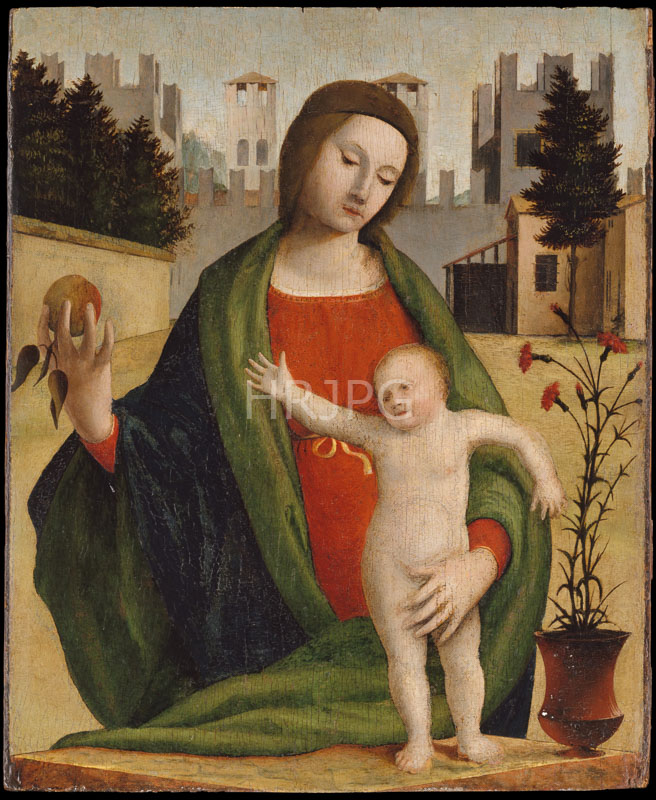
Bramantino, born Bartolomeo Suardi, was one of the most idiosyncratic and visually striking artists of the Milanese Renaissance, and this "Madonna and Child" (often known as the Kleinberger Madonna) exemplifies his unique approach to space, light, and form. While his contemporaries like Luini and Boltraffio focused on the "sweetness" and soft "sfumato" of Leonardo, Bramantino developed a style characterized by architectural rigor, stark lighting, and a slightly surreal, geometric clarity. In this panel, the Virgin Mary is shown seated against a massive, austere stone wall that separates the sacred foreground from a distant, atmospheric landscape featuring classical ruins. This architectural setting is not merely decorative but serves as a structural framework that emphasizes the monumental presence of the figures.
The infant Christ is depicted in a remarkably active and unusual pose, standing on his mother’s lap and reaching out his arms in a gesture that is both a childish embrace and a prophetic foreshadowing of the Crucifixion. Bramantino’s figures possess a distinctive weight and volume; the Virgin’s face is modeled with broad, smooth planes and heavy-lidded eyes, giving her a mask-like, eternal quality. The lighting is cold and direct, casting deep, sharp shadows that define the sculptural folds of the Virgin’s green mantle and red gown. This "chiaroscuro" is much more dramatic and less diffused than the typical Leonardesque style, reflecting Bramantino’s background as an architect and his interest in the radical perspective theories of Bramante.
Technically, the painting showcases Bramantino’s mastery of "foreshortening" and spatial organization. The way the child’s body interacts with the Virgin’s hands and the stone parapet creates a complex series of receding planes that lead the eye into the composition. The background landscape, with its pale, ghostly buildings and misty mountains, provides a poetic contrast to the solid, earthy reality of the holy family. This work reflects the intellectual and spiritual climate of Milan under French rule, a period of transition and cultural experimentation. Bramantino’s "Madonna and Child" stands as a testament to his role as a "modern" master who could synthesize the traditions of the 15th century with a bold, visionary aesthetic that looked forward to Mannerism. It remains a vital piece of the Lombard artistic puzzle, offering a powerful alternative to the more traditional interpretations of the Vinci circle.