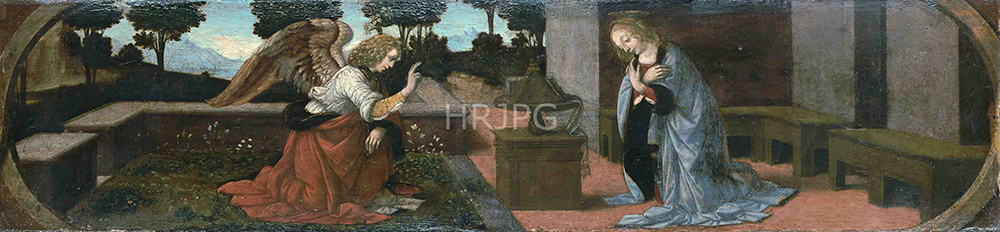
This "Annunciation," currently held in the Louvre Museum, is a pivotal work for understanding the collaborative environment of Andrea del Verrocchio's workshop in late 15th-century Florence. For decades, art historians have debated whether the painting was executed by the young Leonardo da Vinci or his contemporary, Lorenzo di Credi, with many now believing it represents a complex collaboration between the two under the master’s supervision. The scene depicts the Angel Gabriel kneeling before the Virgin Mary in a meticulously rendered "hortus conclusus" (enclosed garden), a traditional symbol of Mary's virginity. The composition is characterized by a profound sense of calm and a rigorous application of linear perspective, which leads the eye through the architectural opening to a vast, misty landscape beyond.
The influence of Leonardo is most visible in the atmospheric treatment of the background and the delicate modeling of the Angel’s face. The "sfumato" in the distant mountains and the soft, diffused light reflecting off the water are hallmarks of Leonardo’s early experiments with aerial perspective. Conversely, the more structured, almost metallic folds of the Virgin’s drapery and the slightly more rigid posture of the figures are often associated with Lorenzo di Credi’s more conservative and precise style. The interaction between the two—the ethereal grace of the angel and the somber, focused devotion of the Virgin—creates a narrative harmony that is representative of the High Renaissance transition. The botanical details in the foreground, where individual flowers and grasses are rendered with scientific accuracy, reflect the workshop's obsession with the "imitation of nature."
Technically, the painting is a masterpiece of small-scale narrative art. Originally part of a "predella" (the bottom series of panels for a larger altarpiece), it demonstrates how Renaissance masters could imbue even minor components with a sense of monumental importance. The use of oil and tempera allows for a rich, luminous surface that has survived remarkably well over the centuries. The "Annunciation" serves as a crucial link between the early Florentine tradition of Fra Angelico and the revolutionary innovations that Leonardo would soon bring to his larger-scale works. Whether as a solo effort or a collaborative workshop project, this panel remains one of the most beautiful and spiritually resonant depictions of the angelic salutation, capturing a moment of divine intervention with a unique blend of mathematical precision and poetic mystery.