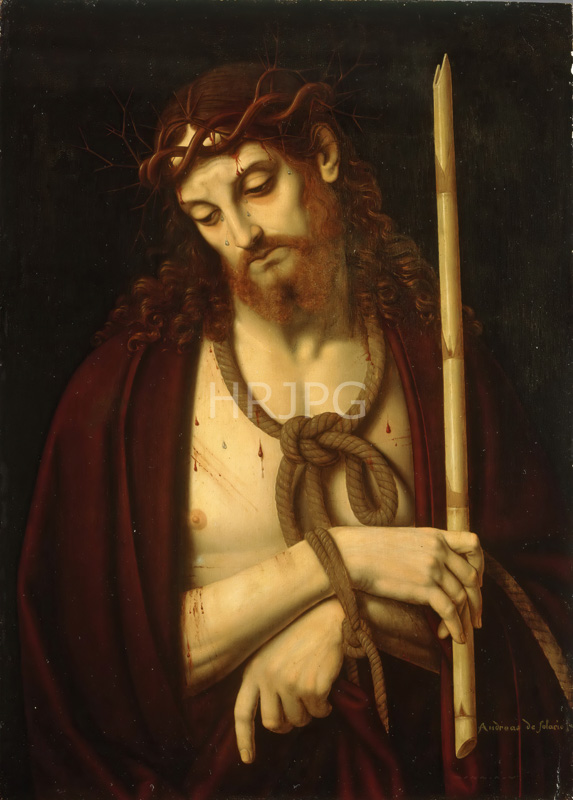
Andrea Solario's "Ecce Homo" is a profound exploration of human suffering and divine resignation, representing a pinnacle of the Milanese school's late 15th-century output. This specific composition, depicting Christ at the moment he is presented to the mockers by Pontius Pilate, showcases Solario’s extraordinary ability to blend the soft, atmospheric "sfumato" of Leonardo da Vinci with the unflinching, tactile realism characteristic of Northern European masters like Hans Memling. Christ is shown half-length, his torso bare and his hands bound by a heavy, coarse rope that seems to bite into his flesh. The crown of thorns is rendered with terrifying precision, each thorn creating a distinct wound from which droplets of blood emerge, adding a visceral layer of pathos to the devotional image.
The lighting in the painting is highly focused, emerging from an invisible source to highlight the delicate modeling of Christ’s anatomy. Solario utilizes "chiaroscuro" not just for three-dimensional volume but as a psychological tool to emphasize the solitude of the savior. Christ’s head is slightly tilted, his eyes downcast in a gesture of silent endurance, while his lips are slightly parted as if in a quiet sigh of agony. This internal, psychological focus was a hallmark of the Vinci circle, yet Solario pushes the physical details further, capturing the varying textures of the wooden reed, the metallic sheen of the blood, and the individual strands of the damp hair. The background remains an impenetrable dark void, a dramatic technique that pushes the figure into the viewer’s immediate space, transforming the act of looking into an act of empathetic prayer.
Technically, the work is a tour de force of oil painting on panel. The skin tones are achieved through numerous translucent glazes, giving the flesh a luminous, almost porcelain-like quality that contrasts sharply with the raw, earthy textures of the rope and the wooden reed. Solario’s "Ecce Homo" became a highly influential archetype for private devotion in Lombardy and France, where the artist later traveled. It reflects a Renaissance shift toward "Imitatio Christi," where the viewer is encouraged to mentally participate in the Passion. This painting stands as one of Solario’s most spiritually resonant works, demonstrating his role as a master who could harmonize intellectual Leonardesque theories with a direct, emotional realism that transcended cultural borders.